What Oma and Opa meant to me
In the previous chapters, I attempted to be as factual as possible, presenting evidence through documents and photographs on Oma and Opa’s life; comments were highlighted like this in italics and grey text. Objective narrative was easier to do in the years before I was alive; in the previous chapter my own commentary began to creep into the narrative.
This last chapter is a non-objective disclosure on my feelings towards my parents, and how they influenced my life.
Oma and Opa as parents
I was very lucky to have extremely supportive parents as I was growing up. I knew that I was an only child, something unusual at the time, and benefited from not having my parents divide their attention between siblings.
Oma was also a stay-at-home mother while I was in elementary school. While many other kids would hang around the school until dinner time when their parents came home, I was never alone, and always knew one of my parents were at home.
Back then, parents didn’t play with their children as they do now; when I was home, Oma would be there doing her chores, and I had to entertain myself. Although we had a TV – we got our first colour TV when I was eleven! – there were no kids shows on until late afternoon (Get Smart was a favourite), or Saturday morning cartoons (which I always seemed to forget to watch). Sometimes, when I did watch a show, and dinner was served (always between 5 and 5:30), I would ask if I could finish watching the show while eating my dinner in front of the TV.
Despite being a single-income household, I never felt that I was missing out on anything materially. Keep in mind that the 60s and 70s were before the era of mass-produced plastic toys: while I had a few Hot Wheels and other cars, for example, these were made from steel, not plastic, and were thus more expensive. Each toy I had was treasured, but also durable – things didn’t break as easily back then. I never owned a soccer ball; back then, the only soccer balls available were made from leather, and extremely expensive. I practiced with a rubber fake soccer ball.
Oma and Opa enrolled me in sports and other activities like swimming and judo, and came out to watch all my games. When I needed a new guitar, somehow the money was found to purchase one. At 14, I took up piano, and a decent piano was purchased for the home.
Opa had finished the basement of the house within a few years of purchasing it, and they rented it out as a one bedroom basement suite for at least a decade in the 1970s. When I was 15 and in grade 10, the last tenant moved out, and Oma and Opa decided it would be a good place for me to live. I lived down there until 1988 when I had finished my Master’s degree; I was 26 when I finally moved out.
During those years, when I was making money as a musician and not paying rent, there were times when I felt the need to purchase something before I had the money in the bank (for example, an Apple IIe computer in 1985). I would ask my parents for a loan, and Oma would simply say I needed to save up the money on my own. Invariably, Opa would come to me afterwards and front me the money, which he never asked me to repay.
Oma/Mutti
I’ve mentioned more than a few times that I was an extremely shy child who had difficulty talking to kids my own age. There were many times were I saw kids playing, and I was too shy to ask if I could join in, so I was left watching from the sideline.
Oma and Opa, recognising that I didn’t have many friends from the neighborhood or school, made efforts to see their friends that had children my age. One such family had a boy who was one year younger than me, Gordie; his parents would allow Gordie to stay with us for a week in the summers, and those were the best weeks of my childhood.
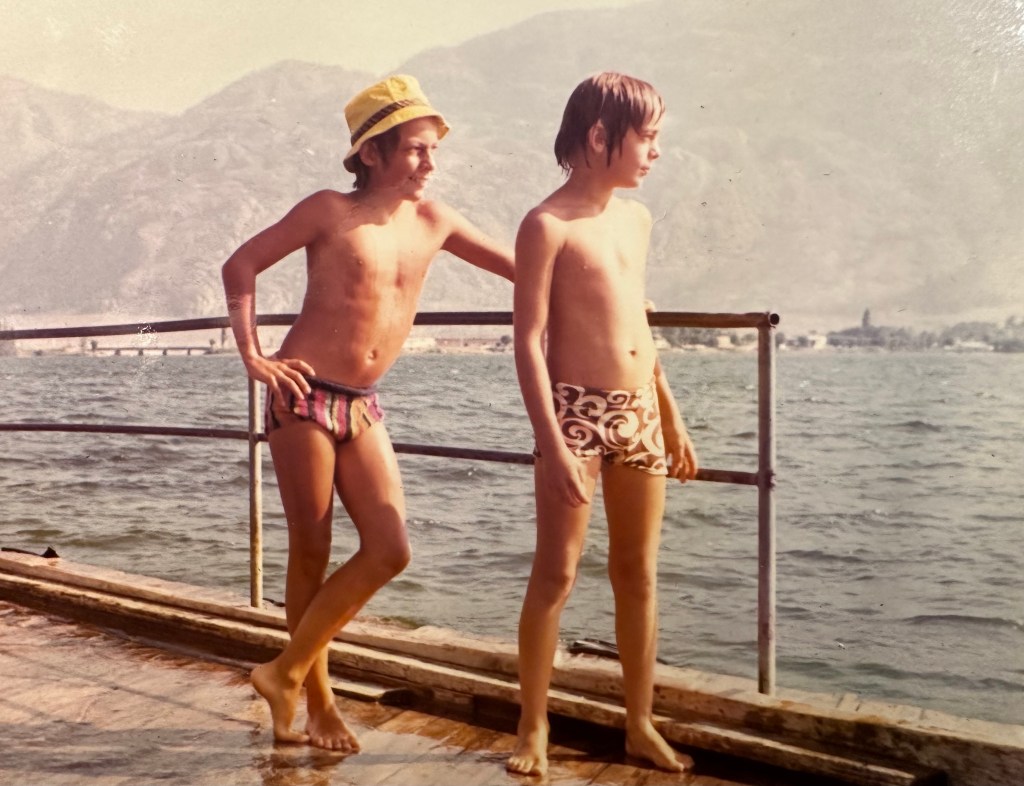
Before grade six, when I did make a close friend at school, I entertained myself at home. I read a lot and spent all of my free time at home. I was close with Oma, and would confide in her my deepest fears and secrets. When I had a huge crush on a girl in seventh grade, and the girl agreed to “go around” with me, I told Oma, of course. I was so excited and nervous that night that I couldn’t sleep, and Oma told me that this wouldn’t do, and I had to “break up” with the girl, which, of course, I did.
Not having an older sibling left me defenseless against older bullies – I never learned to stand up for myself. We had a sizeable native Indian (as we called it back then) population in our school, and these kids came from very large families. Whenever you got into an altercation with a native kid, you knew his older brother would come the next day to “beat you up”. Although I don’t remember ever getting “beaten up”, I do remember more than once coming home crying from street hockey at Queen Mary school, and Oma pulling me back to the school to confront the bully, grabbing him and scaring the heck out of him.
Back then, parents didn’t hesitate to smack their children. I was slapped many times, even into my teenage years, mainly for disrespect or talking back to Oma. She kept a bamboo stick above the stove in the kitchen, and when things got out of hand and she would reach into the cupboard above the stove, I knew I was able to get hit with that. It was never severe, but it sure hurt at the time. Opa only hit me once when I was around eight, for disrespect, and that was both shocking and painful; I know that he regretted it more than I regretted saying whatever I had said.
Oma encouraged me to be different than others. Perhaps this was because I was dressed in homemade clothes when others were wearing store-bought clothes, but she always instilled a sense of confidence in me, that I was as good or better than other people. She continually critiqued me, but rarely to discourage me; instead, it was to make me better.
My first soccer coach, at age eight, a German named Wolf, took an interest in me, perhaps recognising my shyness (and German background). He encouraged me to be a “non-conformist” – this was 1970 after all – and to have confidence in myself.
As someone in the fashion industry, especially after she went back to work when I was 13, Oma also instilled in me a keen awareness of fashion and how to dress properly. While in elementary school, I remember that she would choose the clothes that I was to wear that day and laid them out for me each morning. I happily would wear those clothes without a second thought. By the time I was in high school, I had developed a sense of what clothes go together, and I was always considered a good dresser.
I had always been interested in girls; I remember in grade one having a crush on one girl, and being hugely disappointed when she wrote on the chalkboard “Katherine and Billy, sitting in a tree…”. Ironically, Katherine and I did end up going roller skating together in grade four, and I even went to her house to play guitar together with her. Oma approved on this “relationship” because she liked the parents (the father was in the RCMP). Sadly, Katherine moved away after grade four.
In grade nine, I had much stronger feelings for a girl – Teri – and she returned those feelings. Our first “date” was a school dance. The next day was a band competition in New Westminster – we were both in the band; during that day, we would walk around New West high school holding hands. Our band ended up winning the competition, and had to play that night in the evening concert. Naturally, Oma and Opa came to the concert. Teri and I were happily walking the corridors of New West High, holding hands, when we literally bumped into Opa, who clearly saw that we were holding hands. He didn’t say anything, but smiled.
The next day, I got an earful from Oma, who couldn’t believe that I had a “girlfriend”. She assumed that having a girlfriend at age 14 would lead to sex and drugs, and that I would be “lying in a gutter by the time I was 18”. That’s a quote.
I was torn up. I clearly wanted to keep seeing Teri, but my mother had outlawed it. Teri and I were part of a larger group of band kids who often met to go ice skating or go to movies. Oma would often drop me off at the theatre, park, then hide in the bushes to see if I was alone with Teri or kissing or doing drugs or…
This came to a head when I visited Oma at her work at Jack Fraser Men’s Store in Park Royal. The manager, a young man who Oma loved since he was so young and well-dressed, sat alone with me while Oma finished her work. He asked how old I was, and I told him 14. His response: “Ah, so you must be into girls then”. When I said yes, his next question was “And what does your mother think of this?” When I told him she wanted me to stop dating, he smiled and said “Well, sometimes there are things that you shouldn’t tell your mother.”
I continued to date Teri for several months after that day. That conversation changed the relationship between Oma and me: from then on, she was always suspicious of the women in my life, and somehow resentful of another woman having influence over me.
By the time I was an older teenager, I recognised the dedication that my mother had towards me. She would often tell me how much she loved me, and I came to understand how important I was to her life. There was, unfortunately, some resentment in that, as I wished that my mother could focus on something other than me.
My mother’s relationship to others was also becoming apparent to me. Earlier in my life, I could see that my parents had a friend group, people that they had known for a long time. But one by one, those friends didn’t seem to come around anymore. When I asked, there was always a reason: one friend continued to smoke while my parents had quit by 1970, and Oma wouldn’t let her smoke in the house anymore. Another had said anti semitic statements about the premier of BC at the time, and this was unacceptable. The parents of Gordie, the boy who got to stay with us, ended up having a messy divorce, and that made Oma uncomfortable.
The saddest “breakup” was with our good friends, the Kozors (whose daughter I took to grad); both our families took up skiing together, and we often met up on Mt. Seymour. Oma would sometimes go skiing during the weekday with the mom; one day, Oma phoned Mrs. Kozor to ask if she wanted to go skiing, and was told no, that she was busy. Oma went anyway, and ended up seeing Mrs. Kozor on the slopes, skiing with another friend. Oma was so offended that we didn’t see them again for years.
By the time I graduated high school, Oma and Opa really didn’t have any friends. This was made very clear to me when Opa passed, and there was no one that I could invite to the funeral outside of my friends.
Oma could be very mean to people (ask your mother about some stories!), including those closest to her. But at the same time, I also recognised that my mother would do anything for me, and that she loved me more than anything. But having someone whose happiness depends completely on your actions wasn’t easy.
As an adult, I had a complex relationship with my mother, and when she passed, it was emotional on many levels; I would miss her, but at the same time I wouldn’t miss the drama that she brought.

Opa/Vater
My father and I had a traditional relationship of that time; while Oma was a stay-at-home mom until I was 13, Opa went to work and I saw him in the late afternoons, evenings, and weekends. He was always loving, as much as any father could be loving in those days. I don’t think he ever told me he loved me, but I never doubted that he did.
Again, as already mentioned, Opa and Oma would always come to any soccer or baseball games, never missing one, drive me to sports practices and music lessons. I always felt supported.
Sometimes, I did manage to get Opa to come out and play with me. We both discovered soccer at the same time when I was in grade three; he and I would take a soccer ball across the street and kick it around. I remember we went to a Vancouver Whitecaps game in those early years, and we saw a player execute a bicycle kick (soccer was not on TV at all in those years); the next weekend, Opa and I went out to the field to try it out. He tried doing one, and merely kicked to straight ahead; that was when I realized that any athletic ability I had must have come from Oma, as Opa wasn’t athletic in the slightest.
Opa loved to work with wood in the basement. As I mentioned already, when a friend got his first hockey stick (when no one else had one at that time, since they were very very expensive), Opa tried to make one for me out of plywood. These gestures continued well into my twenties: I bought new speakers, and Opa made me (very rugged) speaker stands; I needed a desk to put all my electronic musical gear on, so Opa made me a very heavy and sturdy desk. Even when we moved into our first house in Maple Ridge, Opa made me a workshop table that was in the garage right up until your mother sold the house.
Opa loved Canadian football for some reason, perhaps because his decade in Winnipeg, football was the only major sport played there; I’m assuming that all the men of Winnipeg were Blue Bombers fans. So every weekend, a football game was on TV. We went to a few games at Empire Stadium in East Van. In 1983, BC Place opened, and we went to see the BC Lions play there several times. This continued until Opa was in his seventies; after taking him to a game in 2003, he told me that that would have to be the last time, as he wasn’t able to walk to the stadium from the parked car anymore. That was a sad day for me.
My life as an academic began to take off in 2004. He was thrilled when I was converted to an Assistant Professor in 2003, buying me an expensive bottle of French wine. I remember being on one of my first research trips, to Marseilles France, in 2006, having dinner in an amazing restaurant and imagining what Opa would think being there. I did manage to tell him a few weeks later how well I was doing, and that my extreme work ethic was directly attributable to his own and the example he had set for me; he simply said he was very proud of me.
Opa tried to support his grandchildren as much as his son, and tried to come out to sporting events for all of you. I remember him telling Ethan he would give him a Looney for every goal he scored; and when he couldn’t come out to see a game, he would pay up on our Sunday visits. Opa turned 80 in 2003, so making trips to Maple Ridge were difficult, and nearly impossible after Oma began showing signs of Alzheimer’s in 2006.
When Opa passed in 2009, I did feel I lost a piece of me. It took me almost two months to recover; for at least one year, I thought about him every day. Although he did see me become a professor at SFU, he never saw the success of his grandchildren in high school, nor the beginnings of their adult lives.
I still think of him often, and miss him dearly.
Reflection
This website was spurred by interest in our family history from Ethan, and initiated a deeper dive into what I knew about my family, and what the resources and photos left to me provided. There were quite a few surprises – for example, the realisation that Opa’s minesweeper was most likely bombed during the weeks following D-Day – as well as the acceptance that there are still so many holes in this history.
For example, Opa told me that he escaped three times from a French prisoner of war camp, but I did not ask for more details (and when I did in our Sunday visits to North Van, Oma ran into the room and shouted “We don’t talk about the war!”).
I wish that I had done an audio interview with Opa, as he clearly remembered so much of his own history, but was reluctant to speak about it. Little stories crept out here and there, but no continuous timeline. Those details will most likely remain lost, as my relatives in Germany do not seem to have additional information (than what I have provided here).
One interesting aspect that emerged through all of this was my DNA testing which confirmed that 54% of my background is from the Baltic region, which includes Lithuania (where my maternal grandmother was from) and East Prussia. Most of that came from Oma, who is 96% Baltic, meaning her history is deeply embedded in that region.
40% of my DNA comes from Germanic Europe, all of which derives from Opa (meaning he was 80% Germanic). A small part comes from Eastern Europe, most likely Poland (just west of the former East Prussia) coming equally (2% each) from Oma and Opa. My little bit of Wales (2%) comes only from Opa. It seems that one of Opa’s parents were not from East Prussia, but Northern Germany, while the other was from East Prussia.
I do remember one time meeting someone from Lithuania who asked me if I was from there as I had the facial structure of a Lithuanian. When I told Oma and Opa, Oma was horrified, saying I was German and that the Lithuanians had “wide faces” (my recent trip to Lithuania did not actually confirm this). She followed this up with saying that my lineage goes back to the Rhineland; curiously, that lineage would have been through Opa rather than her.
Finally, I realised that I can claim that my background is from stolen land, as both East Prussia and Lithuania were captured by the Soviet Red Army in 1945; Lithuania only received its independence from the Soviet Union in 1990 (and its current inhabitants are convinced Putin will reclaim it for Russia any day now), but East Prussia is now a protectorate of Russia, and mainly uninhabited.

Oma always told me that I was German, not Canadian; my first trip to Germany on my own when I was 24 confirmed that I recognised the food, but that was it: I was thoroughly Canadian. Similarly, when visiting Lithuania in the summer of 2024, I recognised some of the dishes, particularly those presenting potatoes (Opa loved potatoes with every meal), but I did not feel any connection with the place or its people even though I am 25% Lithuanian.
Hopefully this effort to collect what I can about our family history is useful to you, if only to give you a perspective on where part of you came from.
Arne Eigenfeldt
November 2024
 Our German Family