Children in East Prussia only went to school until Grade 8; in Opa’s case, that would be until 1937.
Surviving the War
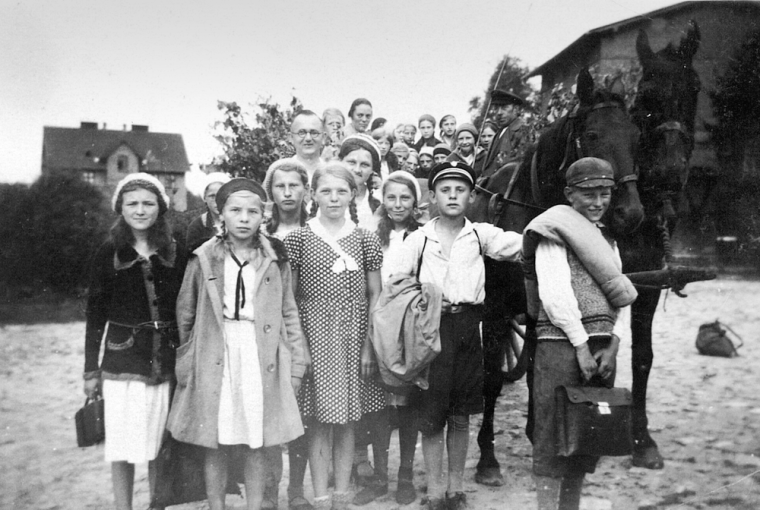
As both Opa and Oma lived in small towns, schools typically were one room with all students learning together.
Speaking with his sister Ula in 2018, she said that Horst was always the smart one in the school, often challenging the teacher. In different times, or a different place, Opa would have continued high school and gone to university.
Opa apprenticed as a baker. There is a letter of recommendation, written in July 1948, that states he worked for a master baker in East Prussia from April 1, 1939 (age 15) until April 1, 1942 (age 18).
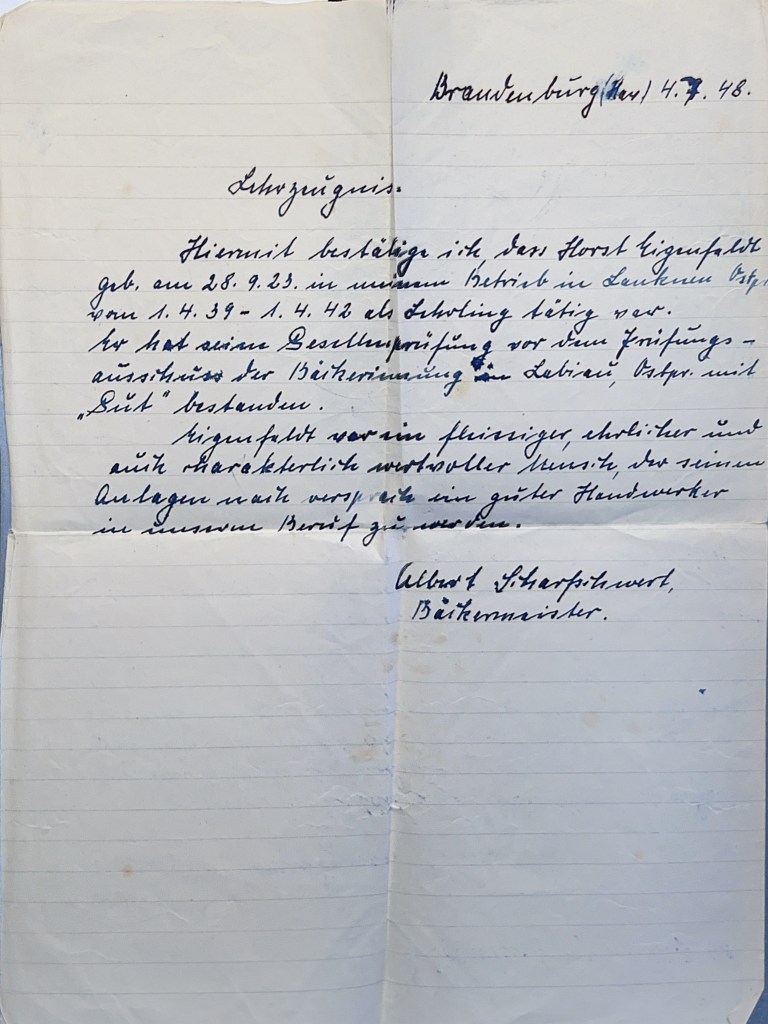
His immigration paper to Canada (April 1954) states he “served as apprentice baker 1939-1942”, and his 1954 German passport lists his occupation as “baker”.
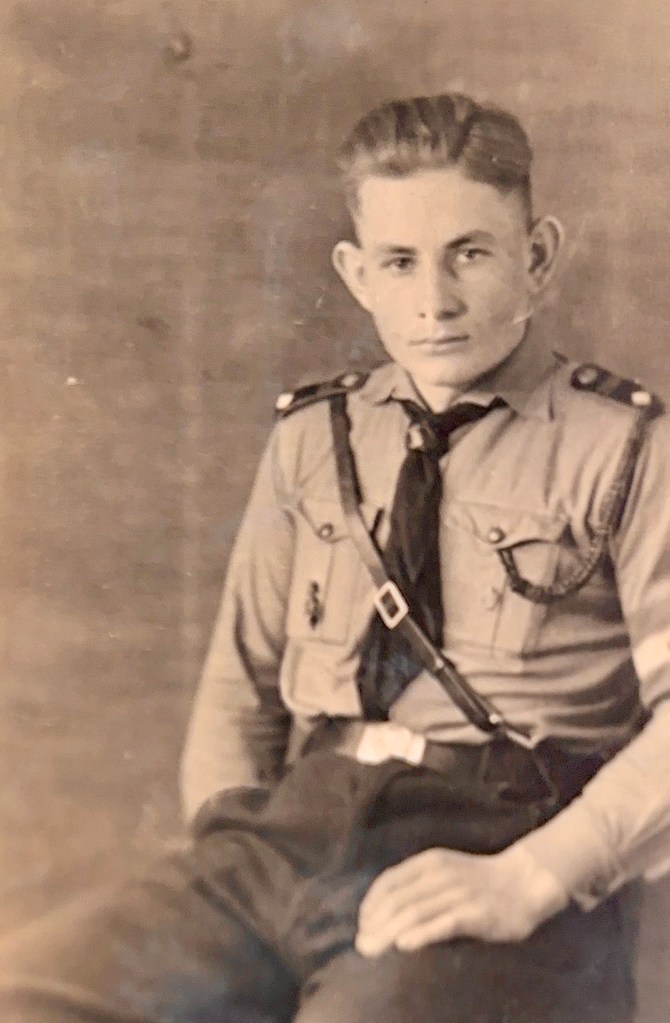
Opa turned 19 in September, 1942. Two weeks later (October 16 1942), he enlisted in the German navy.
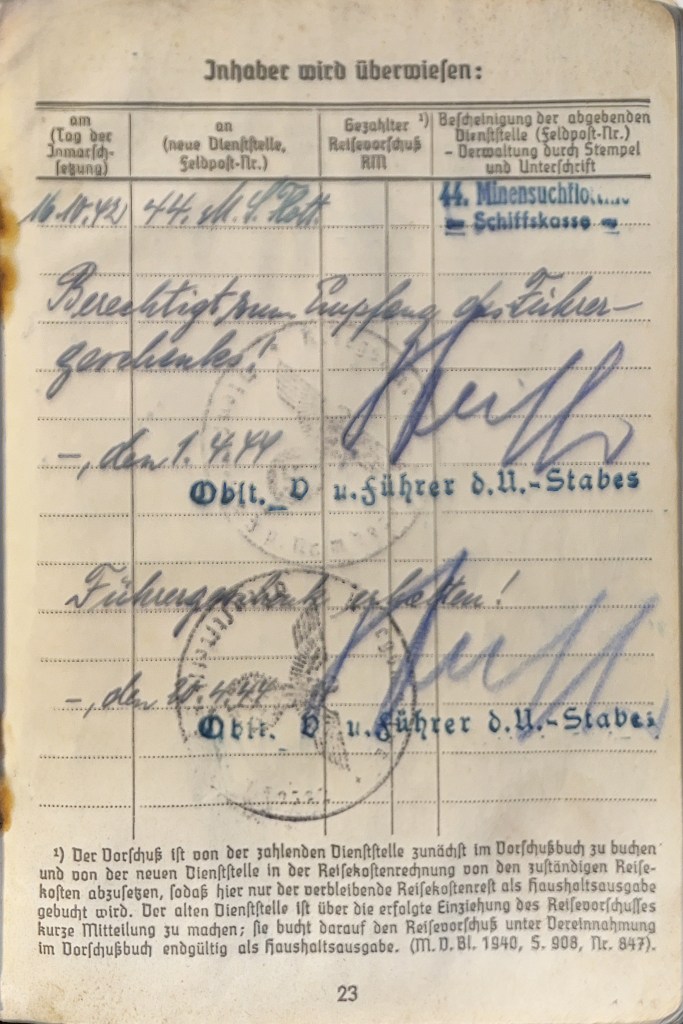
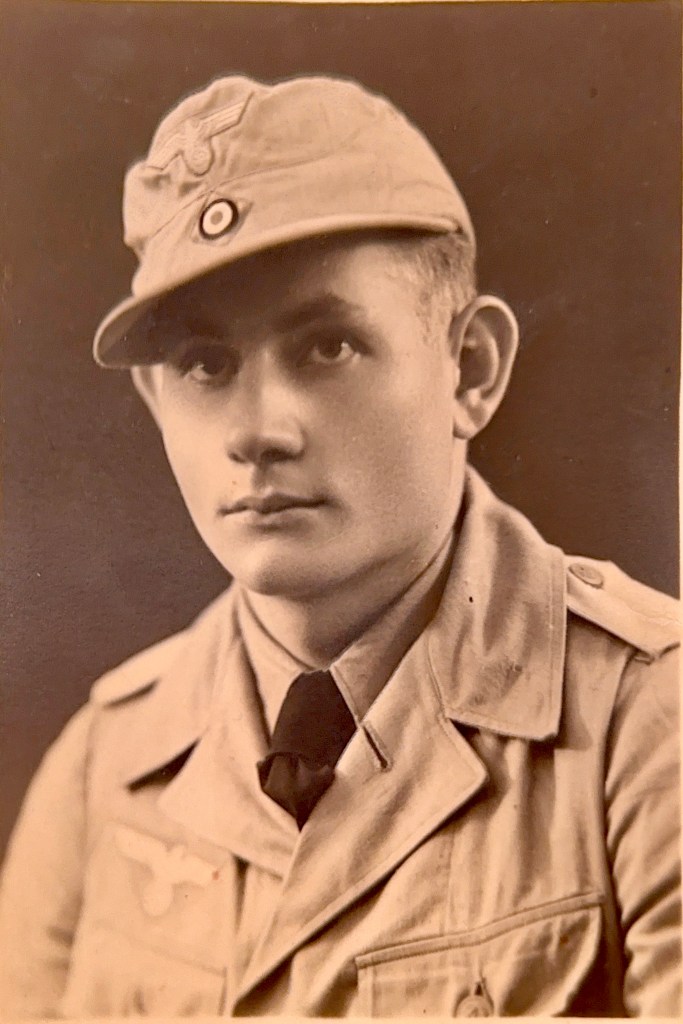
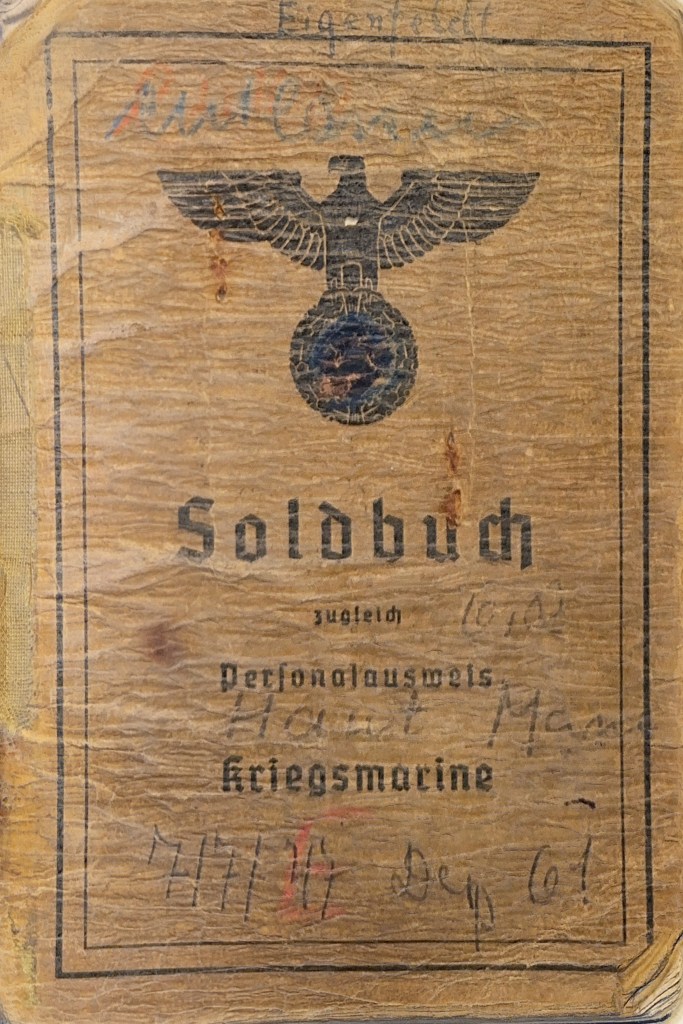
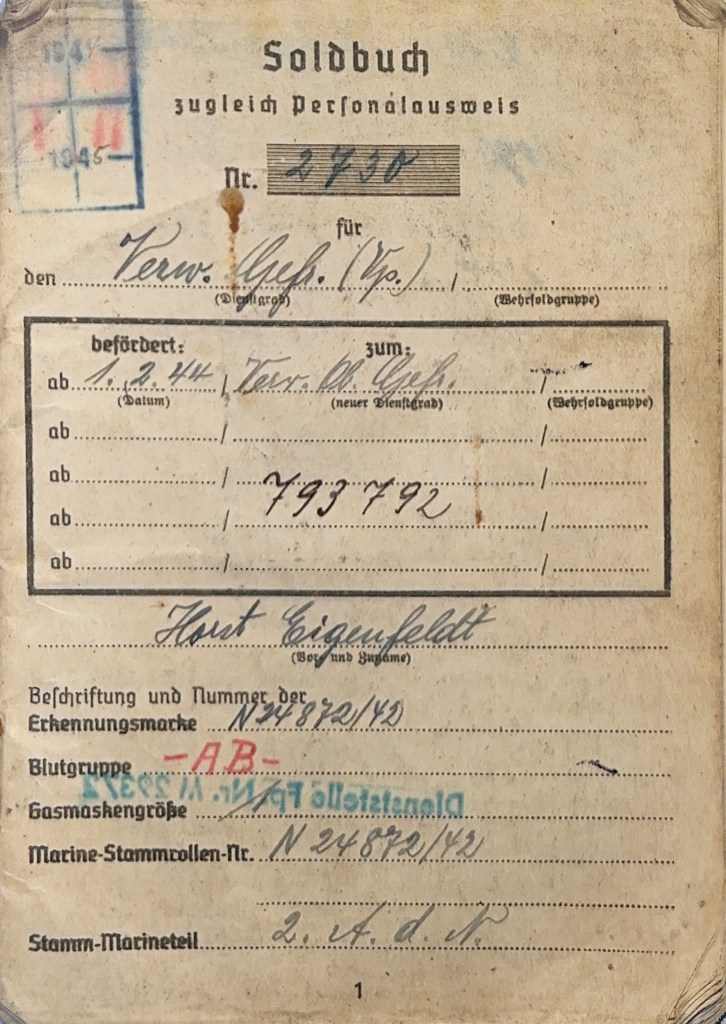
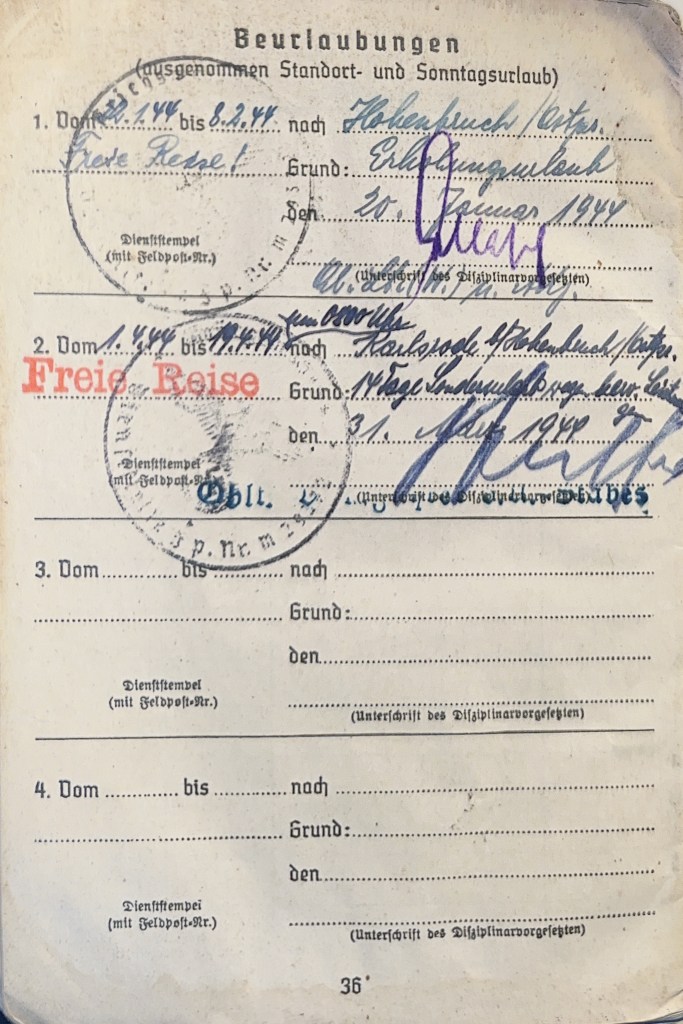
A paybook from the German Navy (Kriegsmarine) from January 1, 1944 includes his blood type, gas mask size, dog tag#, and lists all the clothes and items he was issued, as well as his vaccinations.
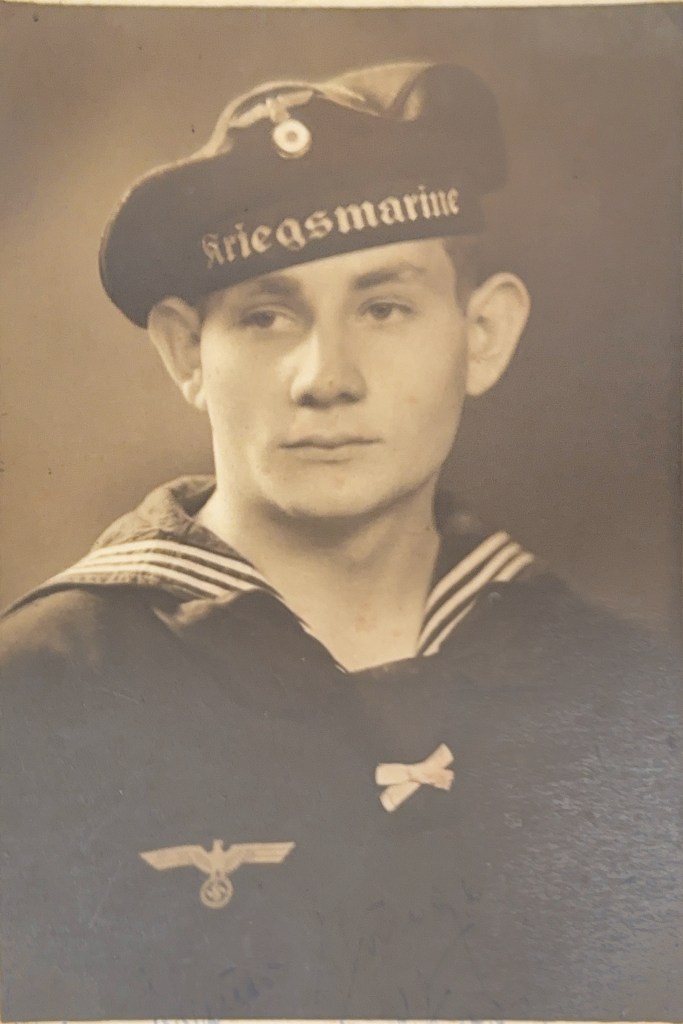
Opa always said he was a cook in the navy. Some photographs (later) suggest that was the case, but there is no documentation beyond that.
Opa told him he used to write stories at night while on his ship. He told me this when I was an adult; I had always assumed that my creative side came from Oma for some reason; it was then that I realised that my creative side came from Opa.
The paybook also shows that he had two leaves: January 20 – February 8, 1944, to Hohenbruch (Oma’s town); April 4 – April 19 1944, to Karlsrode (his hometown).
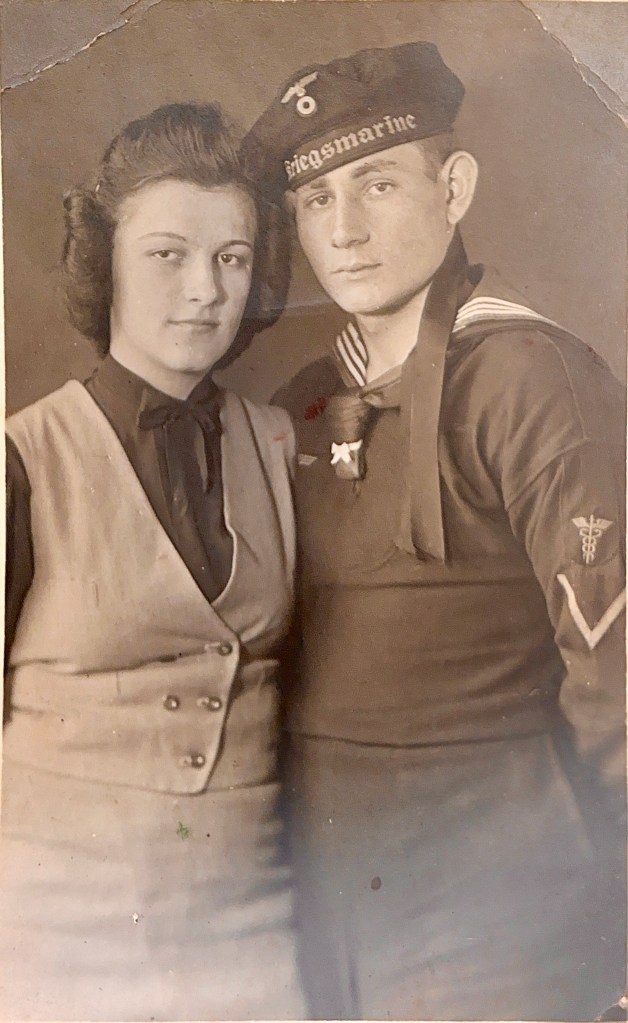
Opa visited Oma in February 1944, when the photo below was taken.
Opa’s second leave in 1944 was to his hometown, but this photo shows he visited Oma’s town as well, as it was taken at a Hohenbruch bakery.
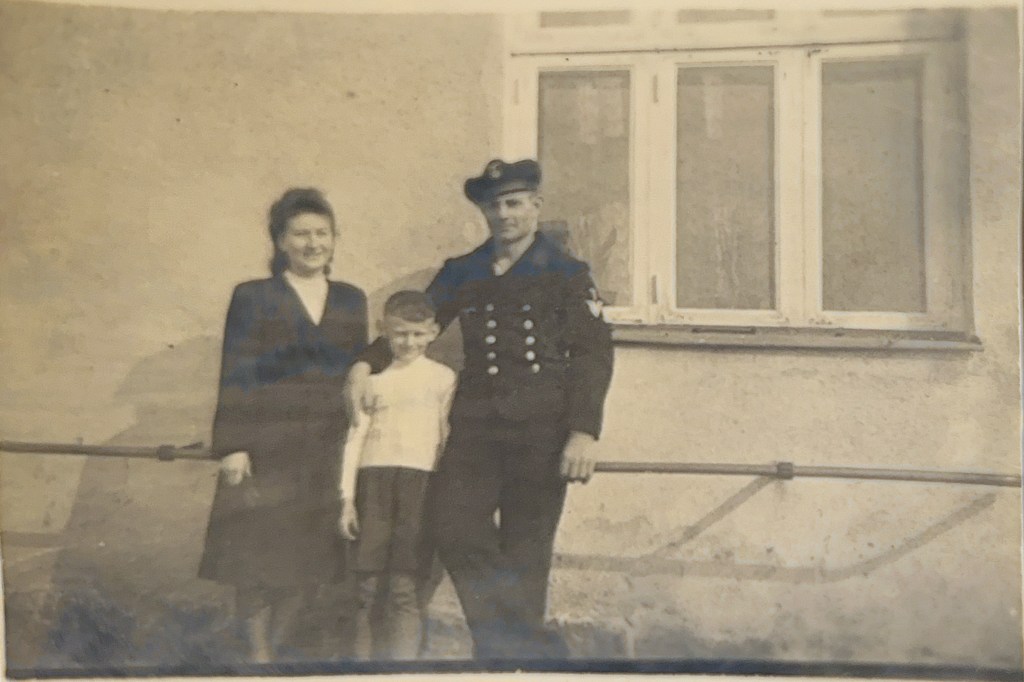
There is another photo from this time with the same two people, identified as Frau Schafswart and Hansi. It is a mystery who these two people may have been.
The fact that Opa’s first leave in 1944 was to visit Oma suggests that they may have met before he enlisted in 1942 (however Oma would have been 13 at that time); more likely, they met during a leave prior to January 1944 when the paybook began.
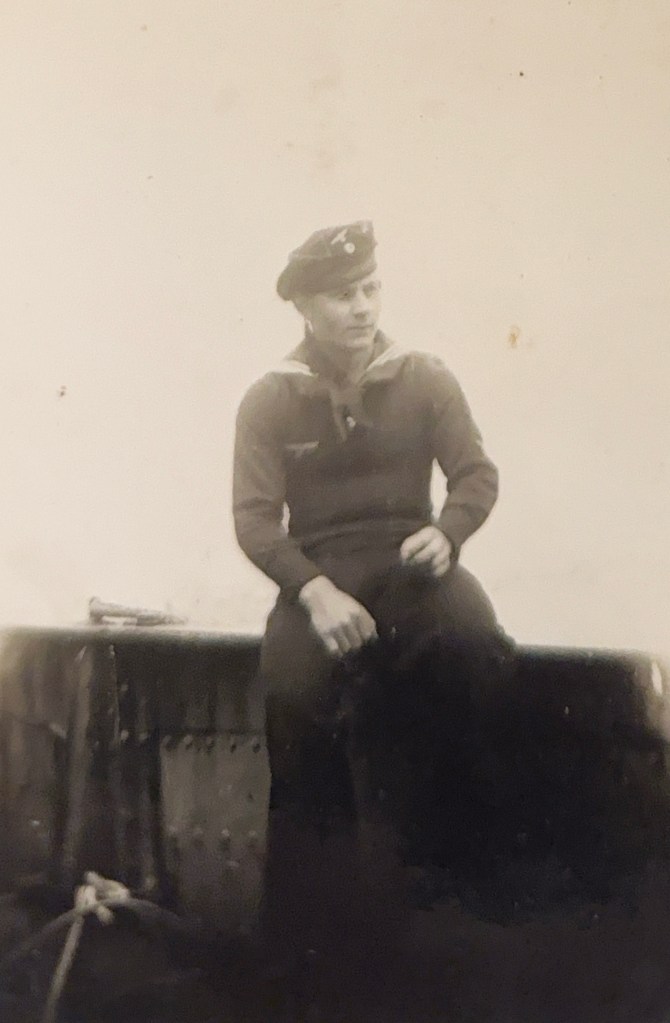
After April 19, Opa returned to his minesweeper, and sent quite a few photos to Oma in May and June of 1944.
Historian Gordon Williamson wrote that “Germany’s minesweepers alone formed a massive proportion of its total strength, and are very much the unsung heroes of the Kriegsmarine.” [Wikipedia].
He told me a story that there were two cooks on the ship, and one of their duties was to bring the Captain a fresh cup of coffee each morning. The Captain always preferred the other cook’s coffee because it was always in a full cup; Opa couldn’t help spilling some of the coffee on the way to the Captain’s quarters on the sea. This went on until the Captain opened his door one morning to see the other cook there, spitting a mouthful of coffee into the cup, his secret to getting a fuller cup to the Captain. From that day on, only Opa brought the coffee.
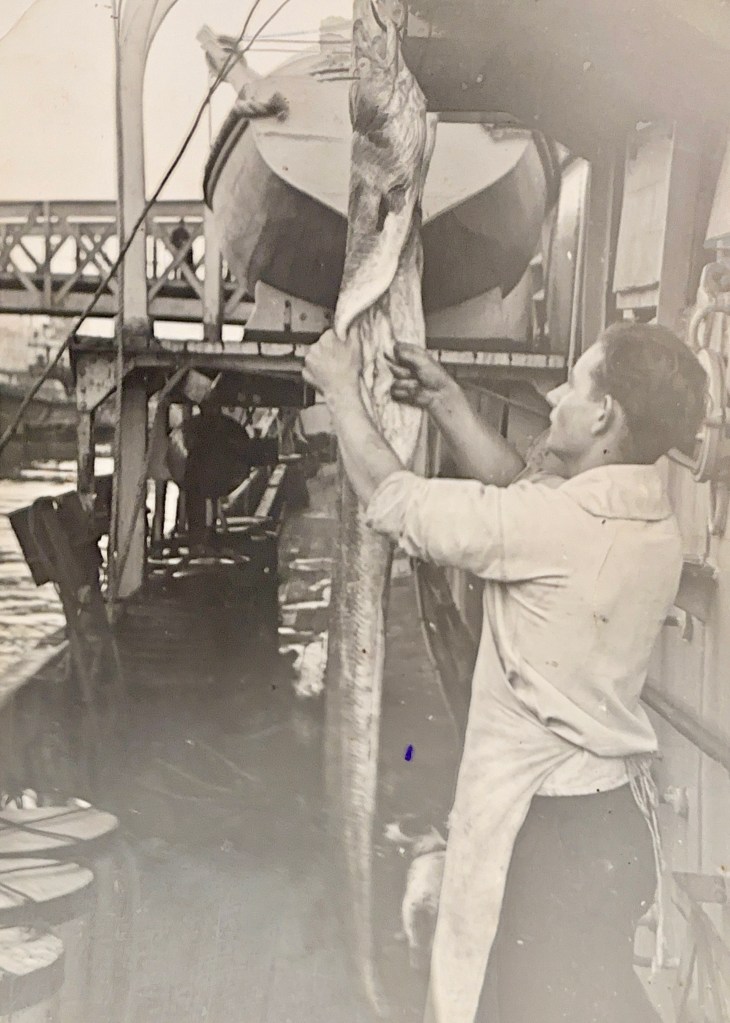
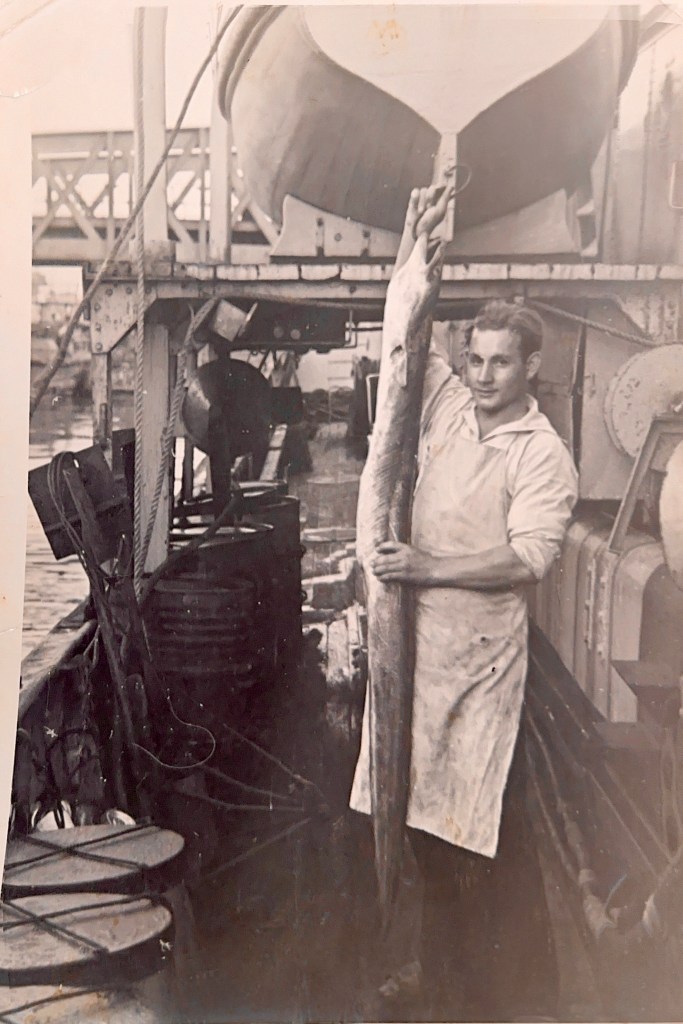
There are a number of photos from May and June of 1944 that he sent to Oma, many of them not featuring Opa in them.
This suggests that Opa was the photographer, and thus took a camera aboard the Navy ship as a personal item (again underlining his creative side).
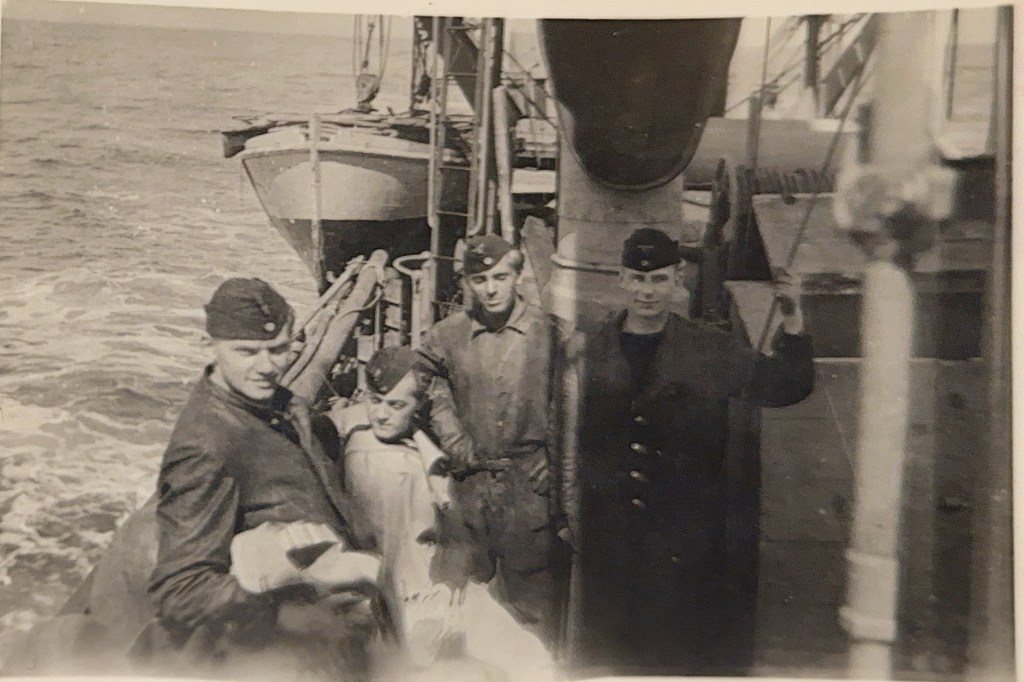
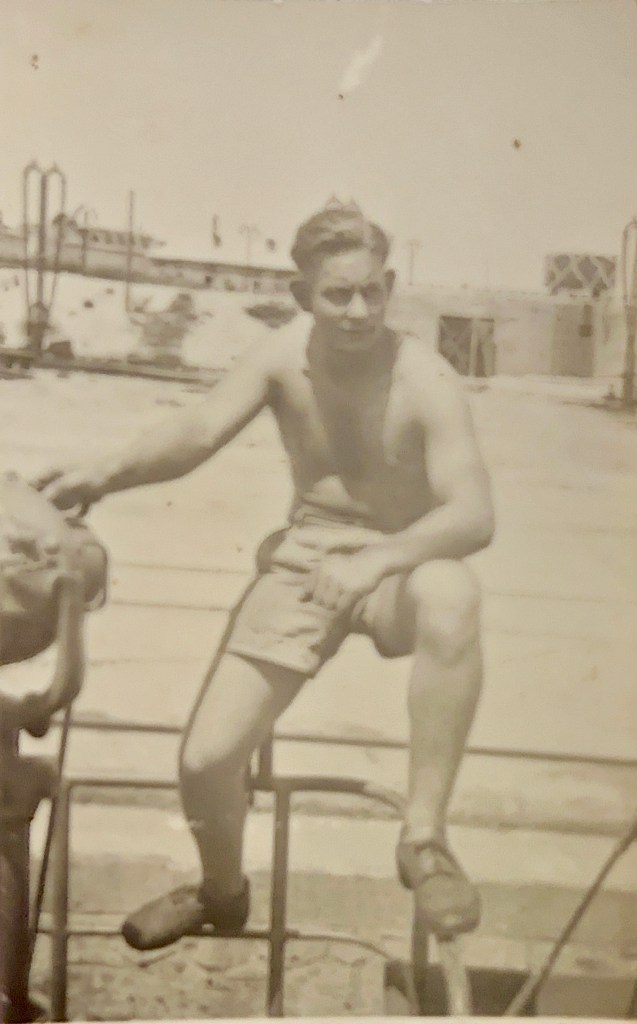
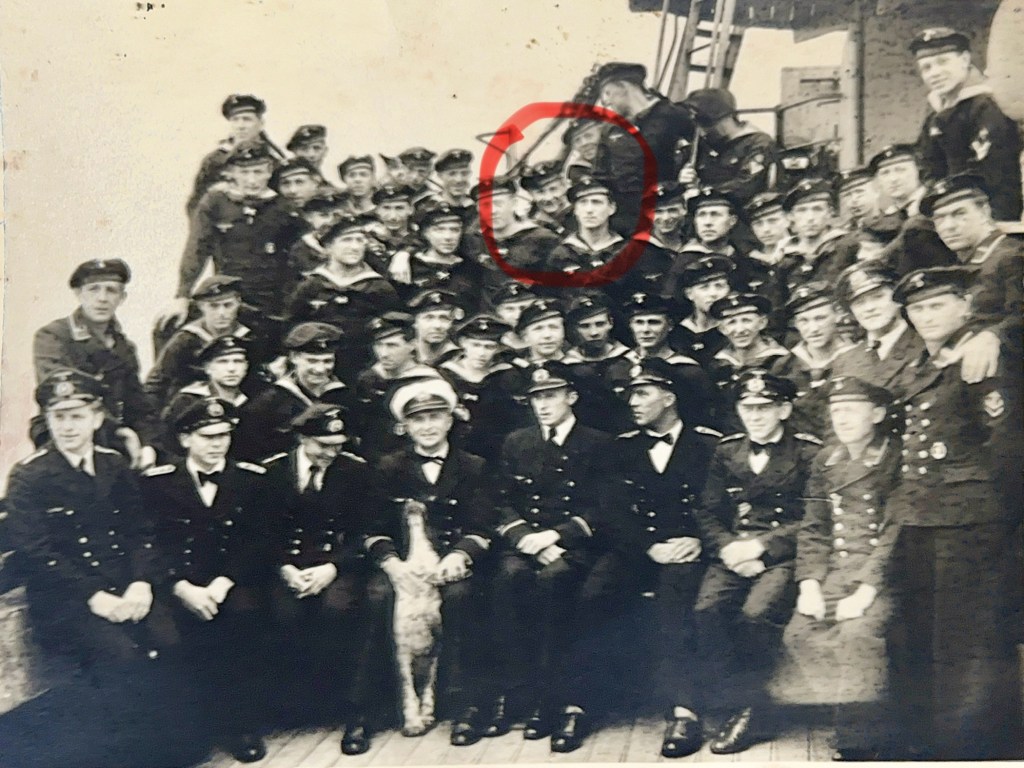
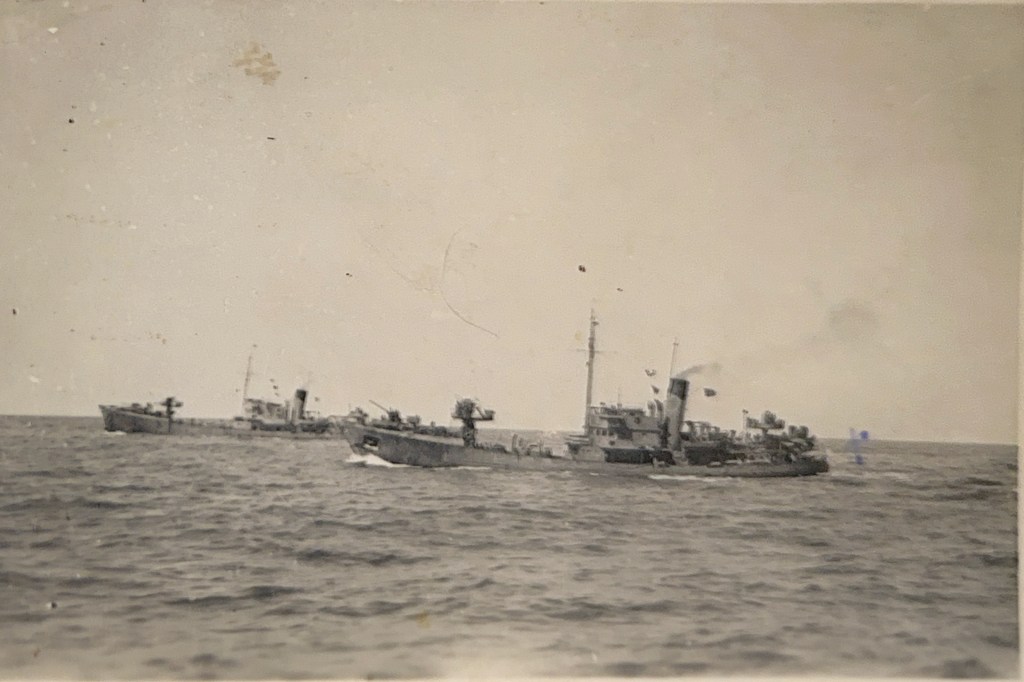
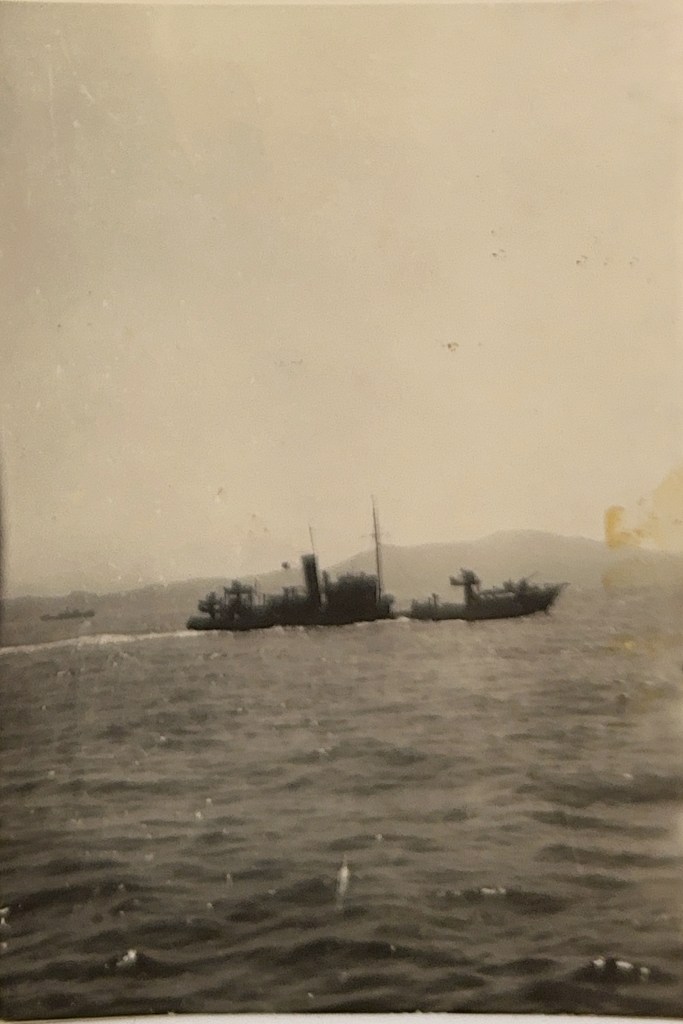
The last of Opa’s photos from the war are June 1944.
Opa said his minesweeper was sunk by Allied fighters off the coast of France, and that he was in the water for eight hours before being rescued. This suggests that this must have occurred in the summer 1944, as the Atlantic would have been too cold to survive eight hours in the fall or winter, or possibly spring 1945 (although the European war ended May 1945). Considering the number of photographs sent to Oma between February and June 1944 and none thereafter, it seems more likely that his minesweeper was hit in the summer of 1944.
German minesweepers were “M-Class”. Opa was on M4456, a converted fishing boat; it was listed as sunk sometime in 1944, the exact date unknown. Over a dozen M-class minesweepers were listed as sunk on June 15 1944 by British aircraft near Boulogne and Le Havre, France.
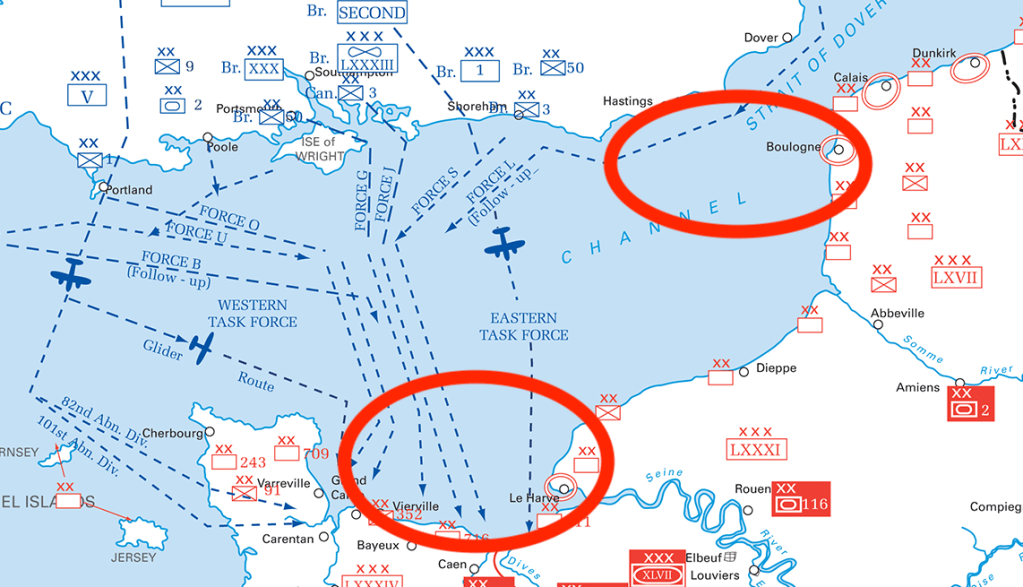
47,00 German soldiers surrendered after being captured in the northwest of Europe to the Allied forces in June of 1944; it is likely that Opa was one of these. This was the time of the Normandy campaign, which followed D-Day on June 6, 1944.
Opa said he was taken into a French prisoner of war camp, and escaped three times. There are no listings of German prisoners of war; there are, however, accounts of German POWs.
Considering the large number of German captives in northwest Europe in the summer of 1944 – over 1 million – it seems likely that security was not high. He may have been held in these prison camps for up to three years as I can’t find any record of him until Fall 1947.
When the war ended in May 1945, the French POW camps were taken over by the government from the military, and conditions improved. Many POWs worked in agriculture in France, and were given enough food to eat and were not treated badly.
Opa said two of the camps were not too bad, but one had a commander who was very cruel, as his family was killed in the war and he despised his German captives.
“Though the Geneva Convention stipulated that POWs should be returned quickly to their home countries, there was no foreseeable end to imprisonment for the former German soldiers in France. Things began to move when the United States started to exert pressure, as it would need the support of western Germany in the looming Cold War against the Soviet Union. Under massive pressure from the United States, in 1947 French officials told the German POWs that the last of them would be able to return home by the end of 1948.” (reference)
There are discharge papers from the German Army, dated October 5 1947, signed by the Irish Guards. His listed address is of his sister in Mörsen (near Hannover) West Germany.
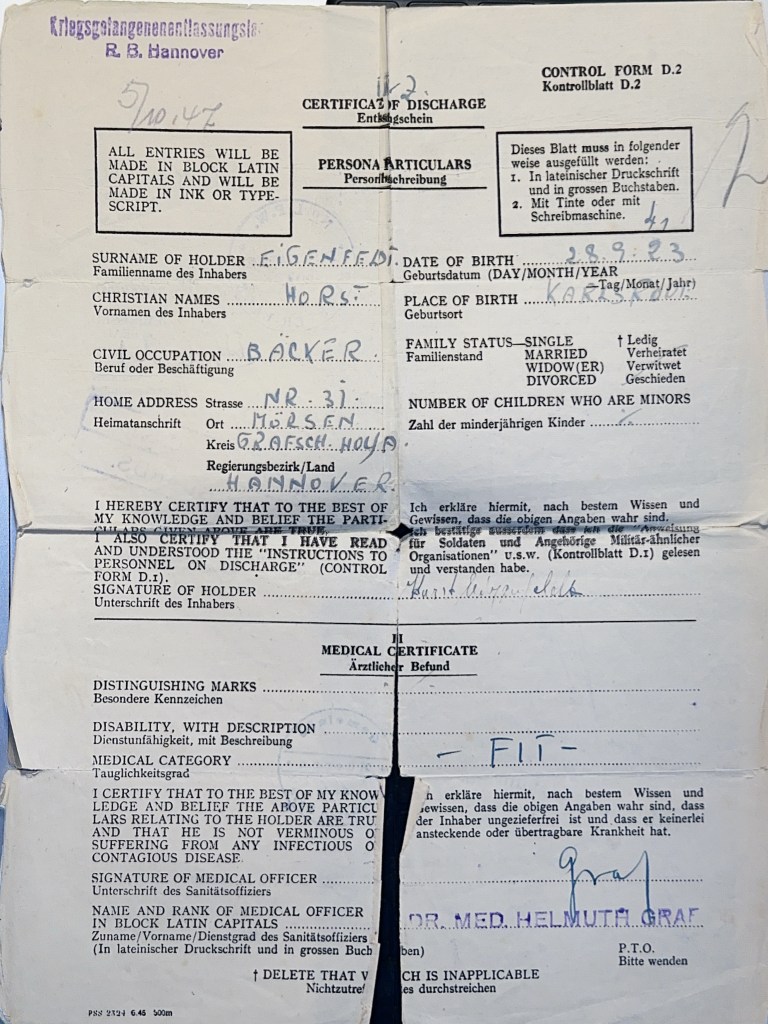
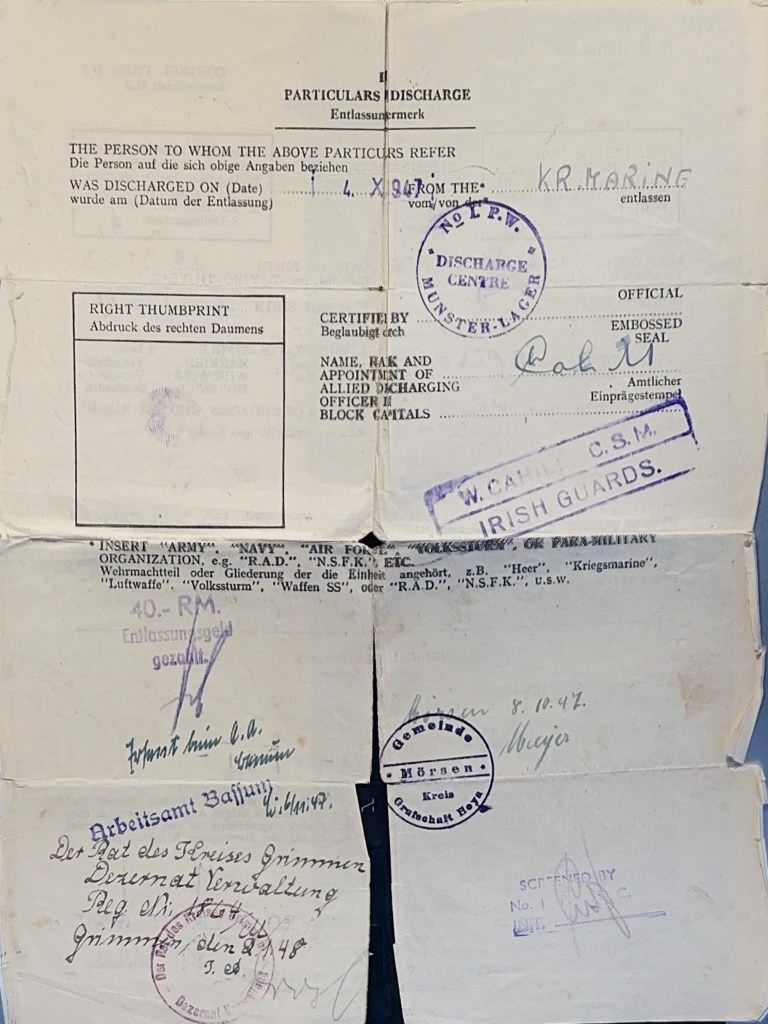
Other stories of German POWs have a similar timeline, in that they were not released from camps until late 1947.
Documents show he arrived in Mörsen, West Germany on October 8 1947, which is where his sister Hildegard and her husband had a farm. As we will see, Horst soon left Mörsen to travel to Berlin in search of his father.
 Our German Family