A Brief German History
Where did East Prussia come from?
What led to its importance in starting World War II?
State of Teutonic Order
This was also the time of the Crusades, where the Catholic church not only attempted to regain the Holy land, but also to Christianize pagans in places like the Baltic states in Northern Europe. In Germany, these knights were known as the Teutonic Order.
The church created a religious state in 1230 in what would later become Prussia: the State of Teutonic Order, which lasted until 1466. It’s capital was Königsberg, or King’s town.
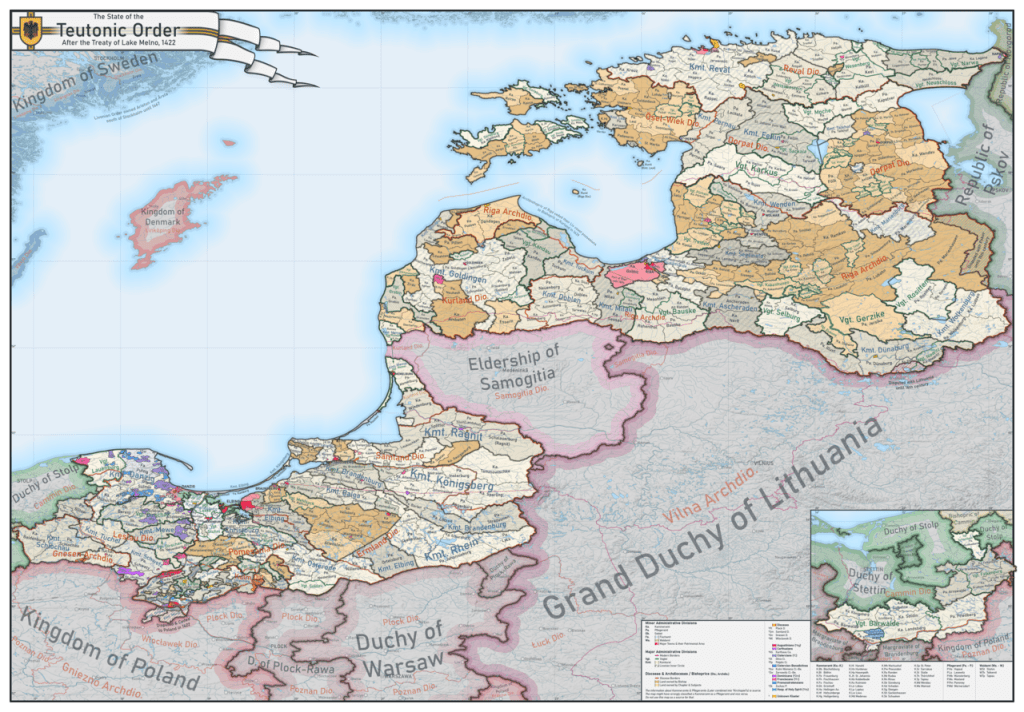
After 1466, the state became secularised, and became the Duchy of Prussia. After the Protestant Reformation in 1525, Prussia became the first Protestant state when it formally adopted Lutheranism in that year.
The Grand Master of the Teutonic Knights, Albert, became the first Duke of Prussia.
Duchy of Prussia & the Reformation
Martin Luther, a German priest, led the Protestant Reformation within the Catholic Church after 1517; the northern and eastern German states became Protestant, while the southern and western states remained Catholic.
That is why Oma and Opa were Lutheran (Protestant), and why Stuttgart and Freiburg have Catholic churches everywhere and people say “Grüss Gott” (Hello to God) as a greeting.
The Thirty Years War (1618-1648) fought in Central Europe (i.e. German states) – mainly between Catholics and Protestants – resulted in up to 8 million people dying in battle, famine, and disease. Some areas experienced a population decline of over 50%.
The end of the war resulted in decentralised power, individual states gained greater autonomy and power at the expense of the Holy Roman Empire.
 Our German Family