A Brief German History
Where did East Prussia come from?
What led to its importance in starting World War II?
The Kingdom of Prussia
Although the Holy Roman Empire lacked the power it once had, it still retained a great deal of influence. During the War of Spanish Succession (1701-14), the Holy Roman Emperor looked by support from non-aligned states. The Duchy of Prussia was actually not part of the Empire, but its leader, the Elector of Prussia, supported the Holy Roman Empire’s cause. Because of this, the Emperor allowed the Elector, Frederick, to crown himself “King in Prussia”.
Frederick’s son, Frederick II, ruled Prussia from 1740-72, and expanded its size by annexing parts of Austria, Poland, and Lithuania. He later became known as Frederick the Great.
Frederick II settled 300,000 German colonists in the eastern provinces of Prussia, aiming to “Germanise” the area.
This is probably why Oma was adamant that we had no Lithuanian heritage, but were originally from the Rhineland.
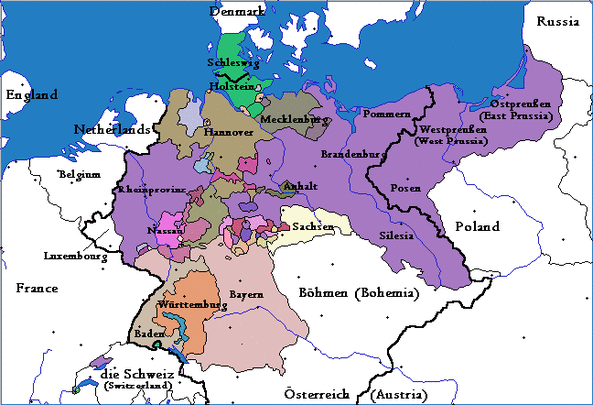
End of the Holy Roman Empire & the Kingdom of Prussia
In 1806, Napoleon was busy conquering Europe, and defeated the Royal Prussian Army. He dissolved the Holy Roman Empire afterwards.
East and West Prussia were combined to become the Province of Prussia.
In the 1800s, the Industrial Revolution modernised the German economy and led to rapid urban growth. Prussia, and its capital of Berlin, grew in power. It became the dominant state in Germany in the 1800s, and was central to the unification of Germany in 1871.
 Our German Family