A Brief German History
Where did East Prussia come from?
What led to its importance in starting World War II?
World War I
East Prussia was a theatre of war during the Great War, when the Russian Empire (pre-Soviet) invaded the country. Most of the German army was on the Western front; however, the Russians were defeated and forced to retreat once more German troops arrived.
Weimar Republic & the Separation of East Prussia in 1919
After their loss in the Great War, Germany was forced to become a republic. Much of Prussia was ceded to Poland.
East Prussia became an exclave, separated from mainland Germany by the Polish Corridor; the corridor was meant to provide access to the Baltic Sea for Poland.
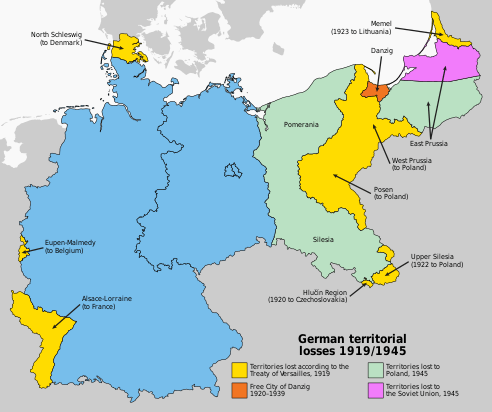
Although many former parts of Prussia were now part of Poland, 42% of the people in the Corridor were German speaking. The free city of Danzig (now Gdańsk) was semi-independent, and was also German-speaking.
Poland-Soviet War 1918-1921
With the creation of the new Soviet Union, its leader, Lenin, wanted access to Western Europe to assist in a widespread communist revolution; thus, he attacked Poland in 1918.
A plebiscite was held in Prussia during this time, under Allied supervision, to determine if the areas should join Poland or remain part of Germany; 97% voted to remain part of Germany.
East Prussia between the Wars
The threat of Soviet-style communism remained during the 1920s and early 1930s, and was one factor in Hitler’s rise to power. In the last free German elections in 1933, East Prussia voted overwhelmingly for Hitler’s Nazi Party, mainly out of fear of the neighboring Soviet Union.
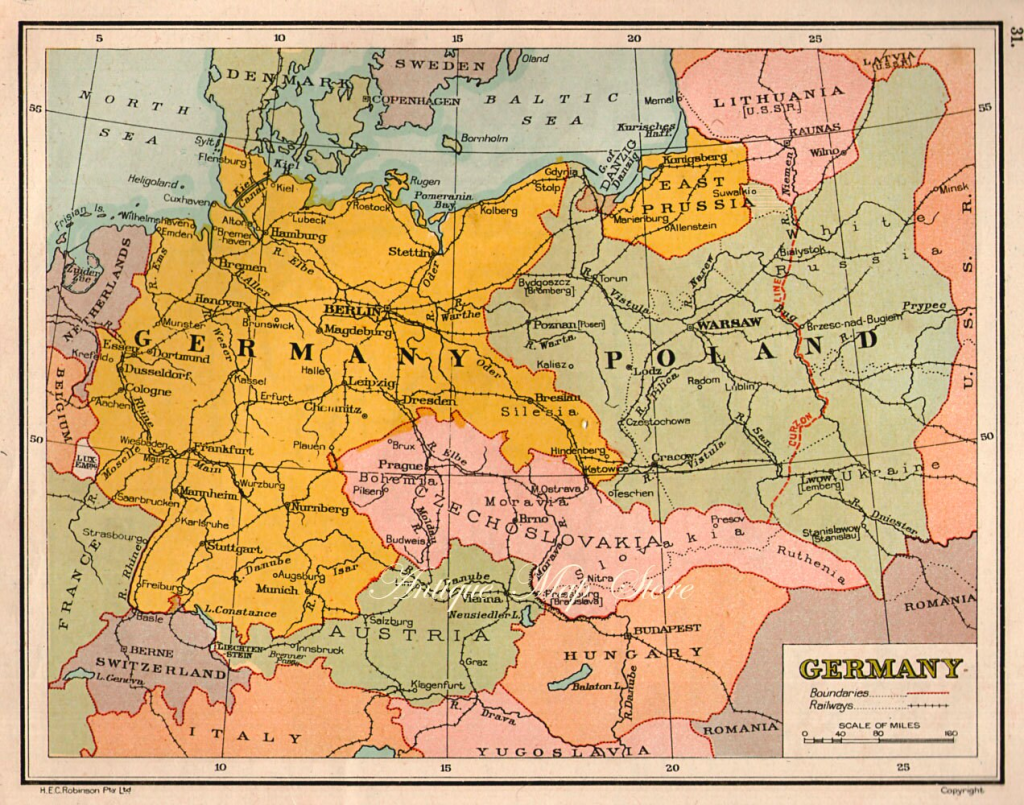
In 1938, the Nazis changed one third of all Prussian place names from the Old Prussian to modern German, in an effort to further “Germanize” East Prussia.
This is why Oma and Opa’s hometowns have two names: the original Prussian and the new German.
In 1939, 85% of East Prussians were German; the rest were Polish (in the south) and Lithuanian (in the northeast).
The beginning of World War II
In August 1939, the Nazis and the Soviets signed a “Treaty of Non-Aggression”, and partitioned Central Europe, including Poland, between them.
Two weeks later, the Nazis invaded Poland on September 1, and World War II began. The Soviets invaded Poland two weeks later.
Hitler’s hope was to connect East Prussia with the rest of Germany. However, of the areas in Poland invaded by Hitler, less than 5% were ethnic Germans according to the Reich’s statistics of 1939.
Despite being one of the major causes of World War I, East Prussia was only slightly affected by the war until 1944.
This is why Oma’s life continued fairly normally between the ages of 11 and 17.
 Our German Family