Reuniting: 1947-1950
Bendigs and Conrads
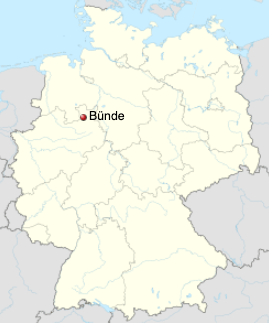
By 1947, the Bendigs and Conrads had settled in Bünde, West Germany. According to Wikipedia, Bünde is the “Cigar Box of Germany” because the German tobacco industry was based there, and many tobacco products – pipes and tobacco jars – were also produced there.
As could be expected, there was a huge housing shortage in war-torn western Germany that led to conflicts between the refugee and local populations. These conflicts only eased in the 1950s with the West German economic boom.
Oma, aged 19, arrived in Bünde with her parents (in their 60s), her sister Charlotte (29), and her children: Helmut (10), Dora (7), and Gerda (6). They stayed in a two-room flat in the attic floor of a house.
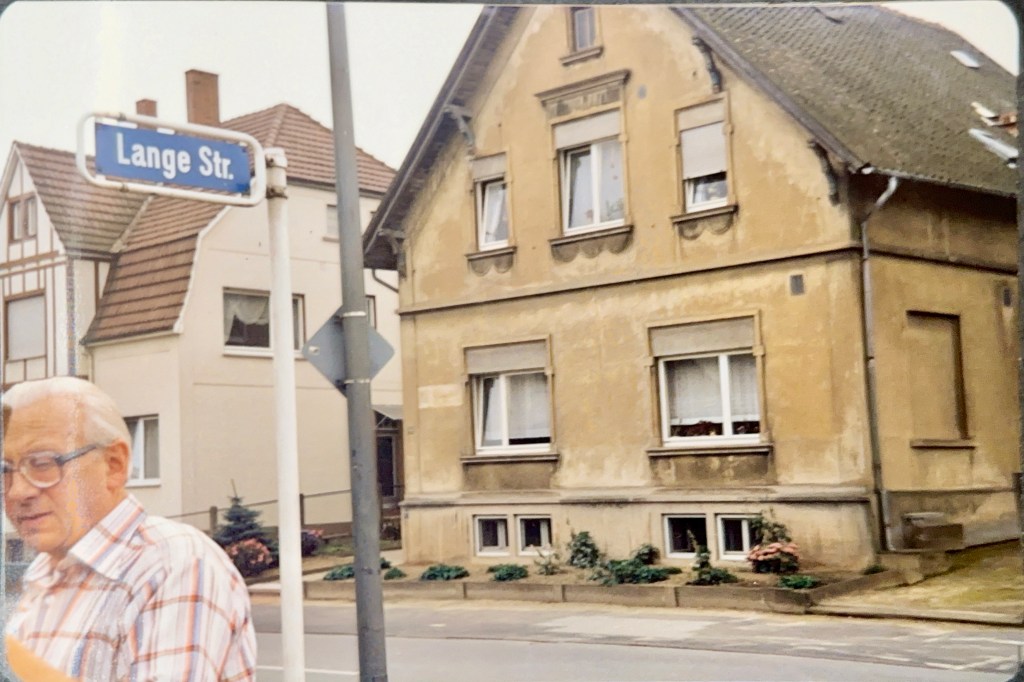
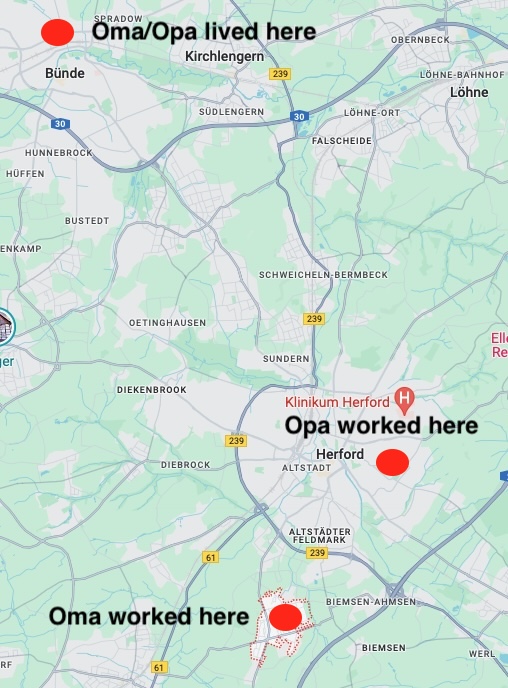
By 1948, Oma and her parents moved to a nearby town – Ennigloh. She began apprenticing as a seamstress for a company in Elverdissen, 18 km away. She had to walk 1.5 km through a forest to the train station, take the train to Herford, then a bus to Elverdissen. She did this for 2 years.
Opa: Mörsen-Berlin-Bünde
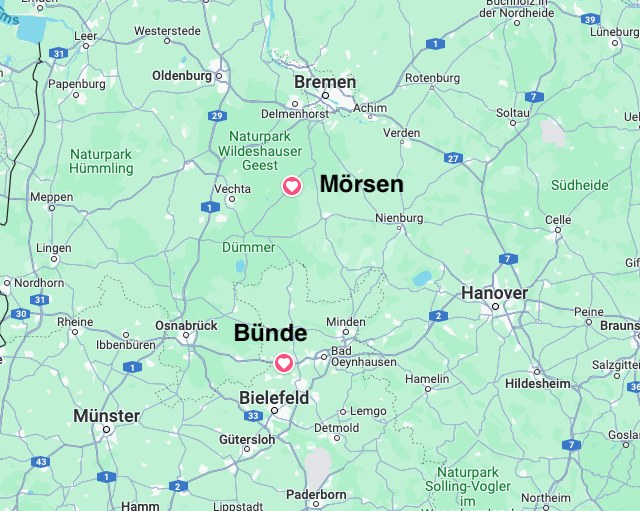
According to my cousin Helmut, Opa “suddenly appeared” around this time. By October 1947, Opa had returned to Germany after being a POW and was living with his sister Hilde Greve and her family in Mörsen, which is only 80 km from Bünde. However, it doesn’t seem like he connected with Oma at this point.
There is a letter of reference dated July 4, 1948, from a master baker in Brandenburg (a part of Berlin).
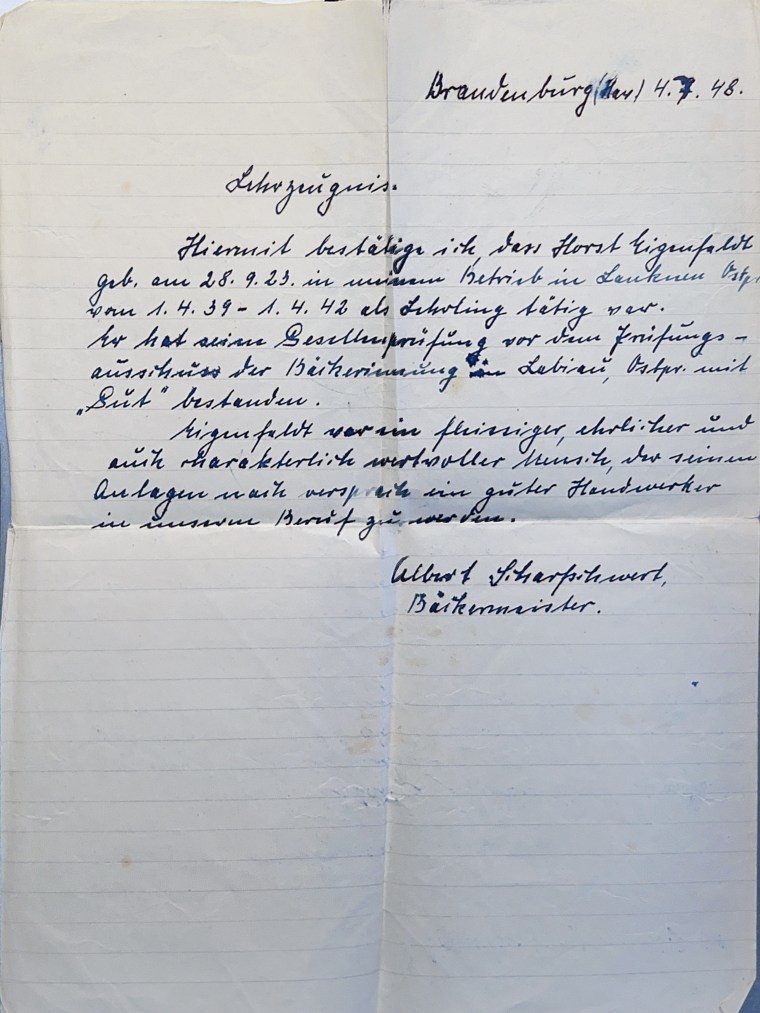
This suggests that Opa left Mörsen, West Germany, and travelled to Berlin to be with his father, Ewald. Ewald had a sister, Luise, who lived in Berlin, so it seems he ended up there after leaving East Prussia.
The above letter seems to have got Opa a job as a baker, as there are two dated photos from this year that show that Opa worked as a baker in Berlin from July 20 onwards.
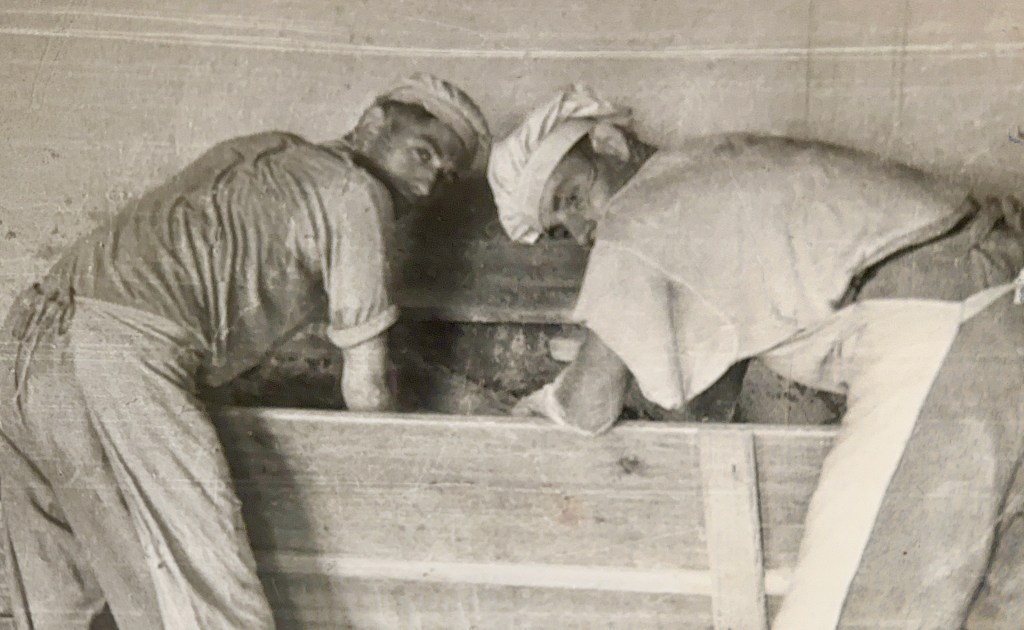
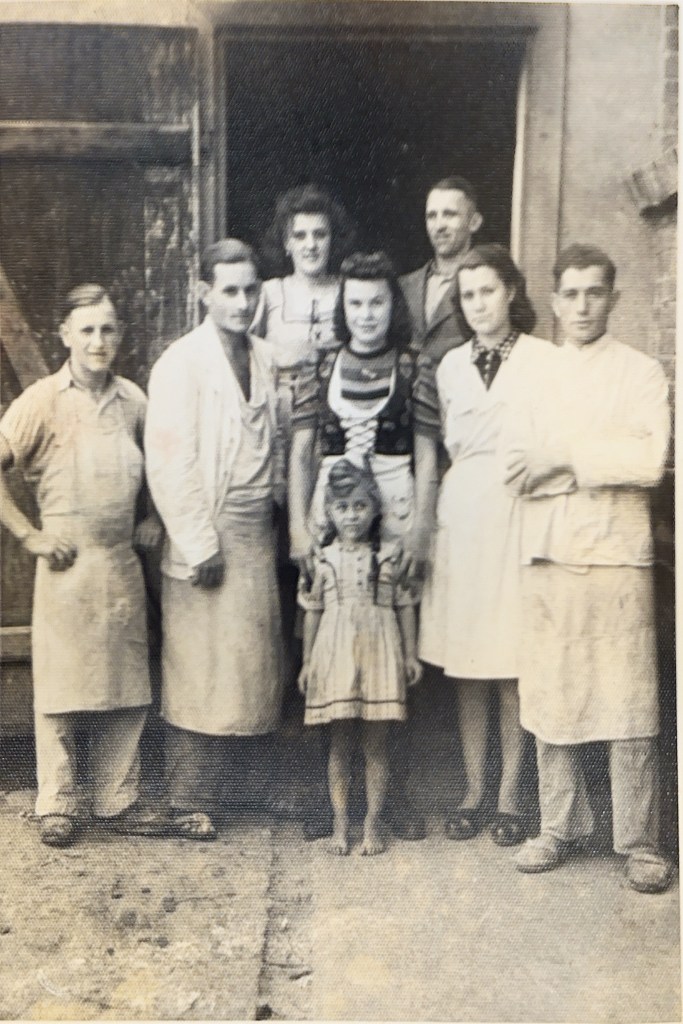
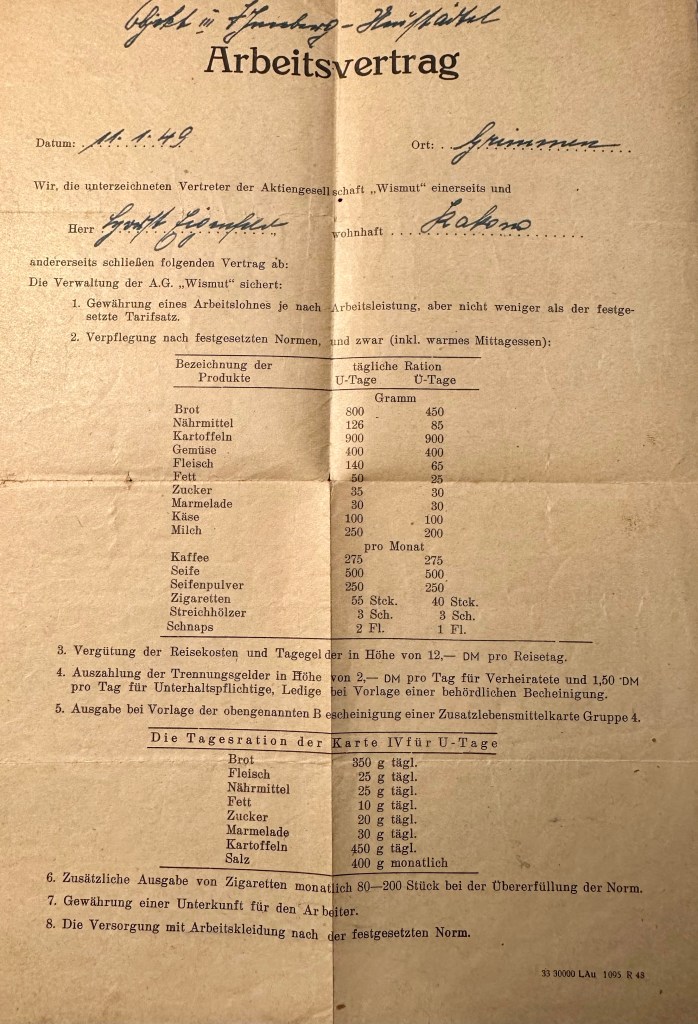
It is unclear why Opa stopped working as a baker at this time, other than he was able to secure another job with better pay and benefits. There is a work contract with the East German uranium mining company, Wismut, dated January 11, 1949.
Berlin, 1948-49
Opa’s travel at this time – Berlin in 1948 and returning to the West in the fall of 1949 – is amazing when one realises the political situation at the time: he was in the middle of the division of Germany and the heart of the burgeoning Cold War.
After the war, the Allied countries – the US, the UK, France, and the Soviet Union – divided Germany into four occupied zones.
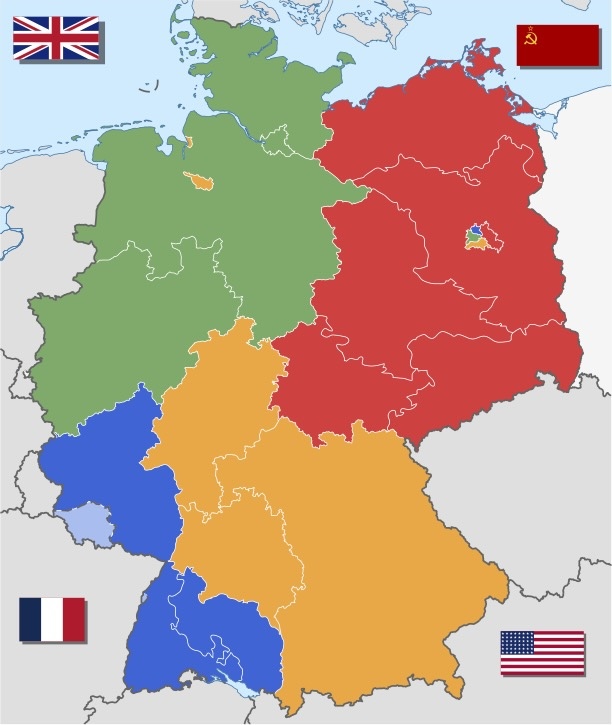
In 1947, political divisions increased between the Soviets and the other occupying allied powers: the latter wanted to rebuild Germany as fast as possible and make it economically self-sufficient and important to the rebuilding of a strong European economy; the Soviets were more interested in reparations and removing factories, equipment, technicians, managers, and skilled personnel to the Soviet Union (reference).
Because the former capital of Germany – Berlin – was divided, the two parts of the city fared differently economically; the economic growth of West Berlin tempted many residents of East Berlin to escape to West Berlin and then further to West Germany. This was called “Republikflucht” (reference).
In 1947, all of Germany used the pre-War Reichsmark as currency, with each occupying country printing its own occupation currency. The Soviets overprinted it, causing severe inflation in the East. Many Germans used cigarettes as a de facto currency for bartering, and there was a rampant barter and black market trade (reference).
Opa told me he sold cigarettes in Berlin on the black market, which makes sense now.
A new Western-supported currency was introduced in Western Germany in June 1948, the Deutsche Mark. The Soviet were completely against this plan, and considered it a threat. The Soviets responded by blocking all Western railway, road, and canel access to West Berlin; this was known as the Berlin Blockade (June 1948-May 1949), the time Opa was in Berlin. During the blockade, it was impossible to leave Berlin, as Soviet guards halted all passenger trains and traffic on the autobahn (reference).
The blockade ended in May 1949 and travel became possible again. By this time, the Soviets were installing communist regimes in their occupied countries: Poland, Hungary, Czechoslovakia, Bulgaria, Romania, and in October 1949, East Germany. This made staying in East Germany even less palatable.
It seems that Opa decided to leave Berlin, and East Germany where his father now lived, and return to West Germany in the fall of 1949 for reasons that are quite understandable.
Opa: West Germany
Opa returned to West Germany in the fall of 1949.
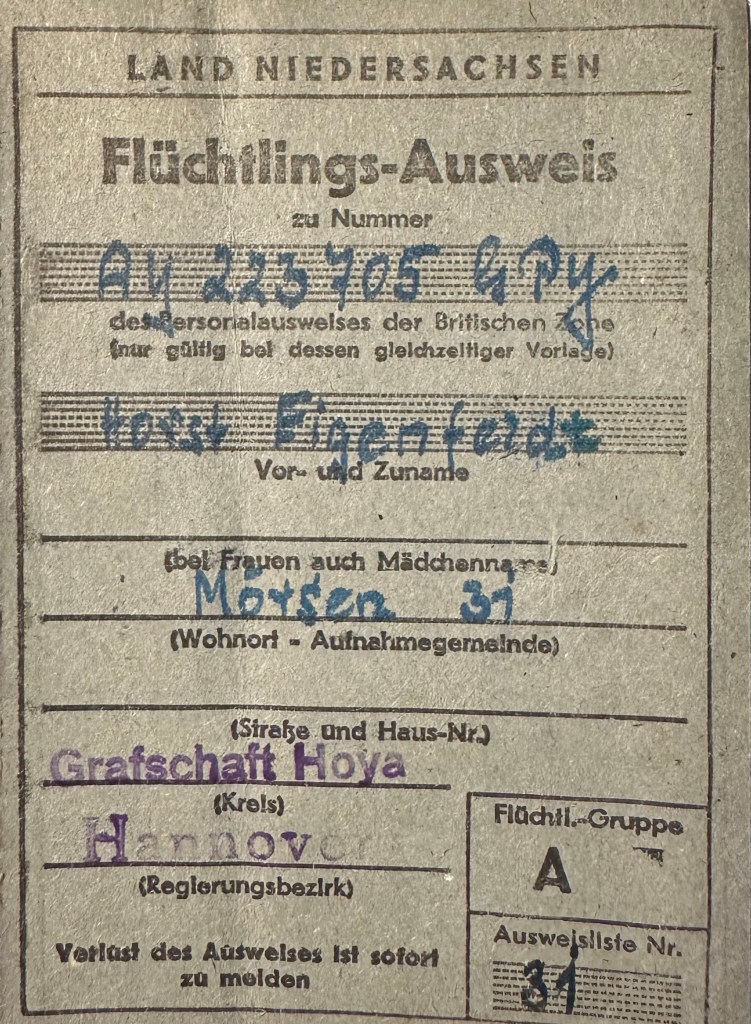
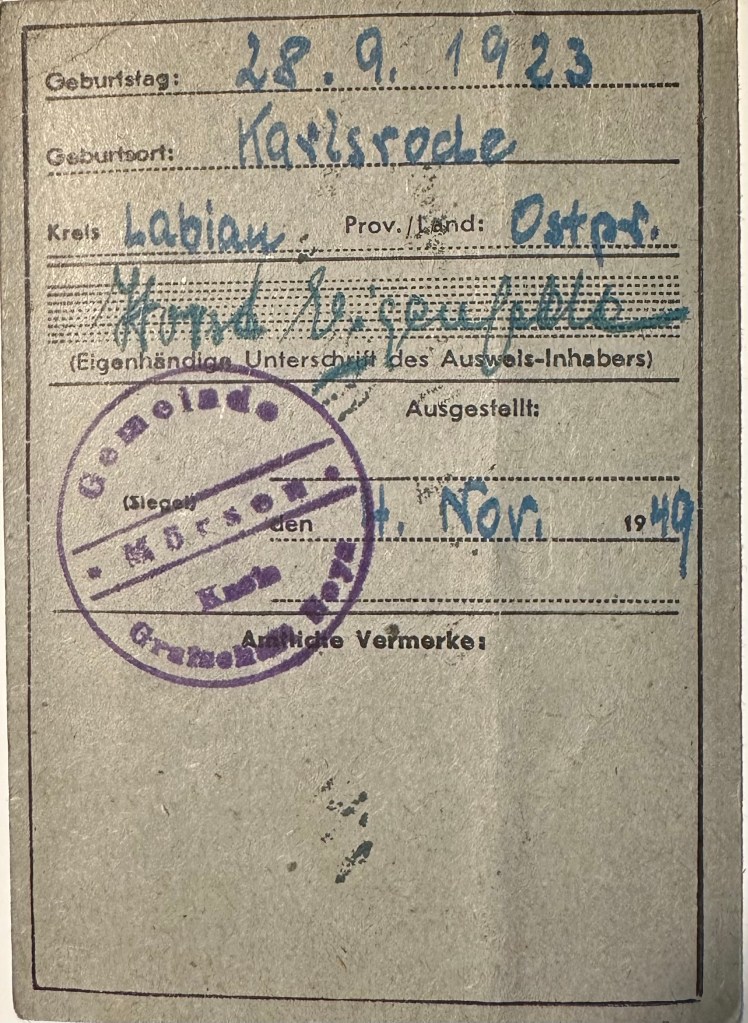
listed as his sister’s home in Mörsen
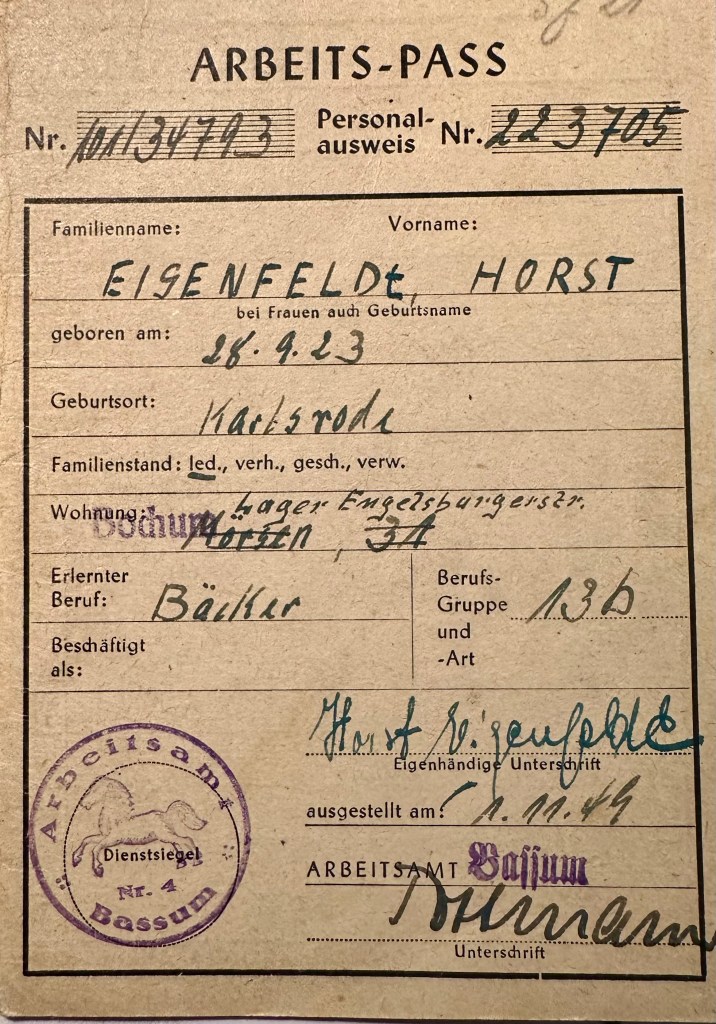
There is a Work Permit that shows his address as a camp (lager) in Engelsburgerstr (which could be the name of a refugee camp), although the issuing agency is Bassum, which is close to his sister Hilde Greve’s farm (where he initially arrived after the war). The date of issue is November 1, 1949.
The work permit shows his first day of work was at his brother-in-law’s company (Gerhard Greve) in Mörsen is October 7, through to November 5, 1949. He began another job in coal mining as a tractor operator at Zeche Engelsburg, Bochum from November 11 until August 15, 1950. The last job listed is in ironworks in Herford, beginning October 16, 1950 with no end date.
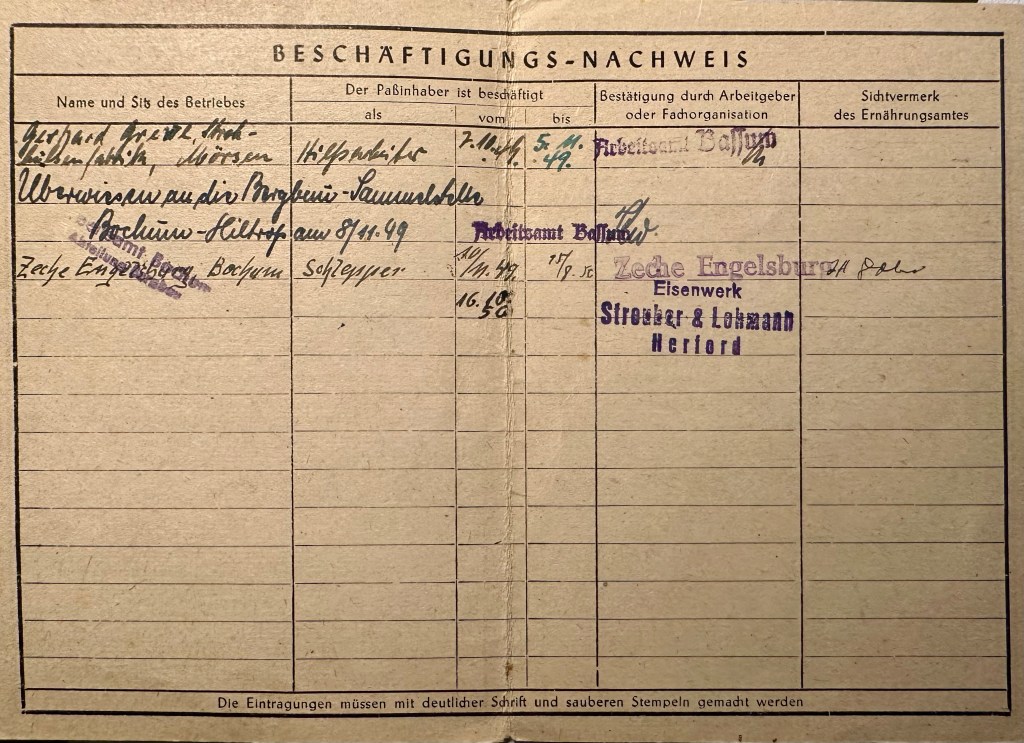
Considering that Oma and Opa were married in September 1950, this means Opa didn’t work in Herford until after they were married.
His union book for the Herford Metalworkers has a start date of January 2, 1951.
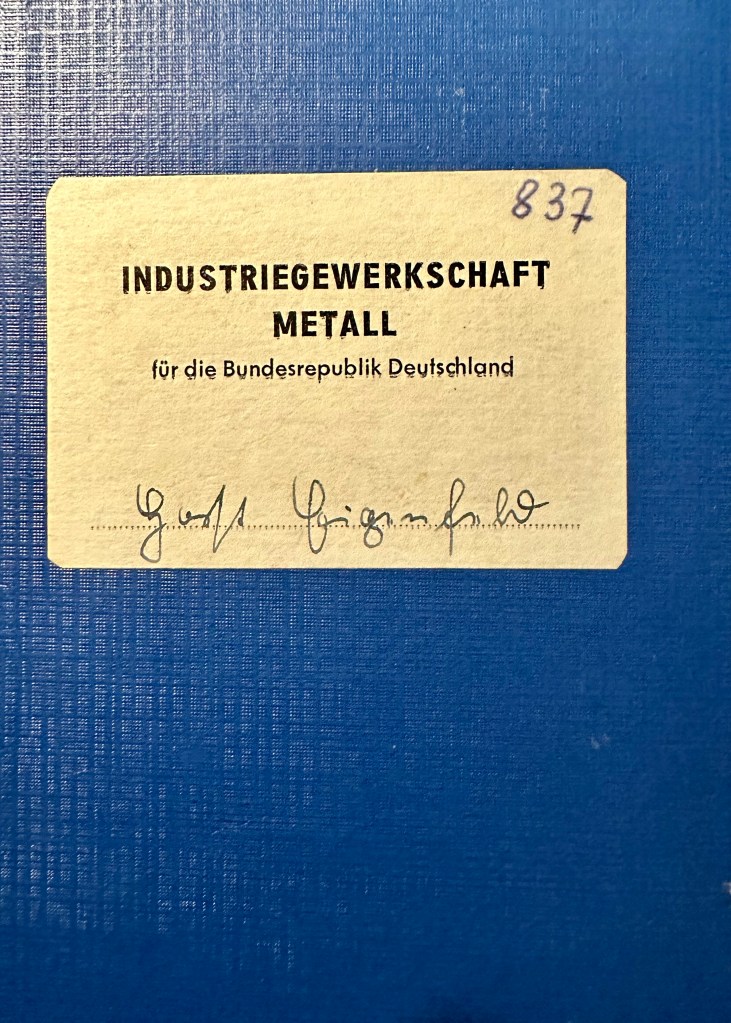
Opa’s immigration papers to Canada from 1954 show that he worked as a general labourer in iron works between 1949 and 1954 (although according to the above work pass, he began in the iron works in October 1950).
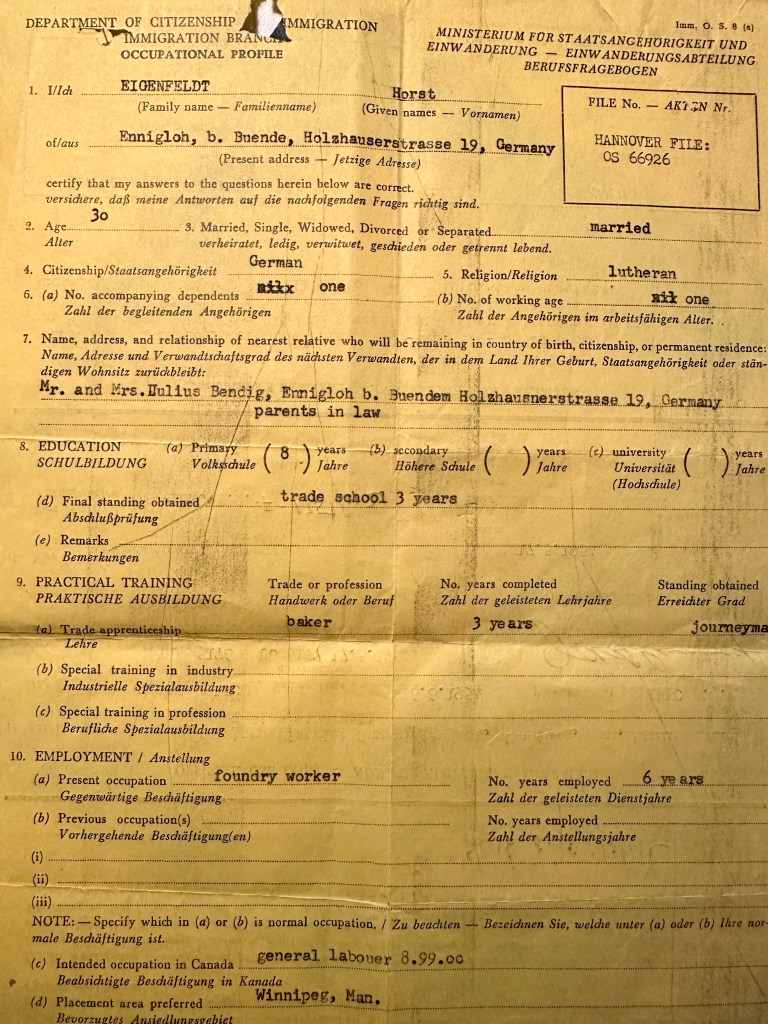
According to Helmut, Opa began working in Herford for an steelworks company that made keys and cups (which is supported by his immigration papers).
The German economy was, not surprisingly, very poor in the post-war years, and to simply find a job and a place to live was extremely fortunate. Given that Opa gave up baking to begin work as a coal miner suggests one did what one had to do.
Summary timeline (Opa)
June 1944 – last communication from Navy, possible POW
May 1945 – end of WWII
October 1947 – released from POW camp
October 1947 – Mörsen, West Germany
July 1948 – Berlin, East Germany (baker)
January 1949 – East Germany (miner)
October 1949 – Mörsen, West Germany
November 1949 – Bochum, West Germany (coal mining)
September 1950 – marriage to Oma
October 1950 – Herford, West Germany (ironworks)
 Our German Family